


Launch your tech mastery with us—your coding journey starts now!
Course Content
MySQL Environmental Setup
Setting up MySQL is the first step toward working with relational databases. Below is a complete guide to help you install and run MySQL on your system, whether you are using Windows, Linux, or macOS. The second step is to start and stop MySQL service on your system. This ensures the MySQL server is running and ready to accept connections and execute queries.
0/2
MySQL Basics
SQL (Structured Query Language) is the standard language used to communicate with relational databases like MySQL. It allows you to create, modify, manage, and retrieve data from tables using simple and powerful commands.
0/5
MySQL Crud Operations
CRUD stands for Create, Read, Update, and Delete — the basic operations you perform on data in any MySQL database. These operations allow you to insert new records, retrieve data, update existing values, and remove records when needed.
0/1
MySQL Joins
In MySQL, JOINs are used to combine rows from two or more tables based on related columns. They are essential when your data is spread across multiple tables and you need to bring it together in one query result.
0/1
Stored Procedures & Functions in MySQL
This section explains the concepts of stored procedures and user-defined functions (UDFs) in MySQL, covering their creation, usage, parameters, differences, control flow, determinism, and advanced behavior — nothing is skipped.
0/6
MySQL Triggers
This section covers everything about Triggers and Events in MySQL — including what they are, how they work, when to use them, all the types available, and how to manage them. Each point comes with simple explanations and examples.
0/4
User Management and Security in MySQL
Managing users and securing your MySQL server is essential to control access, protect data, and prevent unauthorized operations. MySQL provides powerful tools to handle users, assign roles, and enforce fine-grained access control using privileges.
0/2
MySQL Performance Tuning
MySQL Performance Tuning is the process of optimizing how your database server, queries, indexes, and schema work together to provide the fastest and most resource-efficient responses. When a database starts to slow down under load, tuning ensures better speed, reduced CPU/memory usage, and quicker access to data — especially for high-traffic applications or large datasets. It involves query optimization, proper indexing, schema design, and server-level configurations that reduce delays and improve efficiency across all operations.
0/8
Query Optimization Techniques in MySQL
Query optimization is the process of writing SQL queries in a way that minimizes execution time and resource usage (like CPU, memory, and disk I/O). MySQL’s optimizer decides the best way to execute your SQL query, but your query structure can drastically impact performance. By following smart query practices, using indexes, avoiding expensive operations, and understanding how MySQL executes your statements, you can dramatically boost your database performance.
0/1
Replication in MySQL
0/1
MySQL

The sample tables used in the following examples are:-

1. Customer Table

2. Order Table

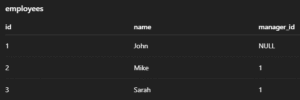
3. Employee Table

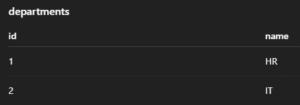
4. Department Table

5. Marks Table

6. Student Table

1. INSERT INTO – Add New Records

Inserts new rows into a table. Values can be inserted into all or selected columns.

Syntax:

INSERT INTO table_name (column1, column2, ...)
VALUES (value1, value2, ...);

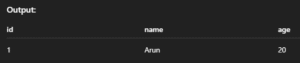
Example:

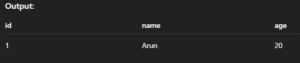
INSERT INTO students (id, name, age) VALUES (1, 'Arun', 20);

Output: 

2. INSERT IGNORE – Skip Duplicates Silently

Inserts data but skips the row if it violates uniqueness constraints like PRIMARY KEY.

Syntax:

INSERT IGNORE INTO table_name (column1, column2, ...)
VALUES (value1, value2, ...);

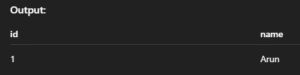
Example:

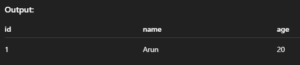
INSERT IGNORE INTO students (id, name) VALUES (1, 'Arun');

Output: 

3. INSERT … ON DUPLICATE KEY UPDATE – Upsert

If a duplicate key is found, updates the row instead of inserting a new one.

Syntax:

INSERT INTO table_name (column1, column2)
VALUES (value1, value2)
ON DUPLICATE KEY UPDATE column2 = new_value;

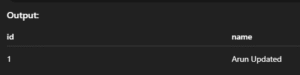
Example:

INSERT INTO students (id, name) VALUES (1, 'Arun')
ON DUPLICATE KEY UPDATE name = 'Arun Updated';

Output:

4. SELECT – Read Data from Table

Retrieves data from one or more tables. You can select specific columns or all (*).

Syntax:

SELECT column1, column2 FROM table_name;
-- OR
SELECT * FROM table_name;

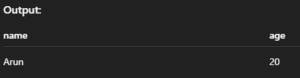
Example:

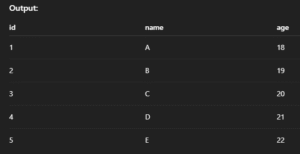
SELECT name, age FROM students;

Output: 

5. SELECT DISTINCT – Avoid Duplicate Rows

Returns only unique records from the selected column(s).

Syntax:

SELECT DISTINCT column_name FROM table_name;

Example:

SELECT DISTINCT age FROM students;

Output: 

6. SELECT WHERE – Conditional Read

Filters records based on a given condition.

Syntax:

SELECT column1, column2 FROM table_name WHERE condition;

Example:

SELECT * FROM students WHERE age > 18;

Output: 

7. SELECT ORDER BY – Sort Results

Sorts the output in ascending (ASC) or descending (DESC) order.

Syntax:

SELECT * FROM table_name ORDER BY column_name ASC|DESC;

Example:

SELECT * FROM students ORDER BY age DESC;

Output: 

8. SELECT LIMIT – Limit Output Rows

Fetches only a fixed number of rows from the result.

Syntax:

SELECT * FROM table_name LIMIT number_of_rows;

Example:

SELECT * FROM students LIMIT 5;

Output: 

9. SELECT LIKE – Pattern Matching

Finds rows where column values match a specific pattern using % or _.

Syntax:

SELECT * FROM table_name WHERE column_name LIKE 'pattern';

Example:

SELECT * FROM students WHERE name LIKE 'A%';

Output: 

10. UPDATE – Change Existing Data

Updates values in one or more columns for selected rows.

Syntax:

UPDATE table_name
SET column1 = value1, column2 = value2
WHERE condition;

Example:

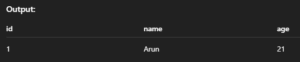
UPDATE students SET age = 21 WHERE id = 1;

Output: 

11. UPDATE with JOIN – Modify Using Related Tables

Allows updates based on matching rows in other tables.

Syntax:

UPDATE table1
JOIN table2 ON table1.column = table2.column
SET table1.column_to_update = value
WHERE condition;

Example:

UPDATE orders o
JOIN customers c ON o.customer_id = c.id
SET o.status = 'Confirmed'
WHERE c.city = 'Chennai';

Output: 

12. DELETE – Remove Data from Table

Deletes rows matching a condition from a table.

Syntax:

DELETE FROM table_name WHERE condition;

Example:

DELETE FROM students WHERE id = 1;

Output: 

13. DELETE with JOIN – Delete from Multiple Tables

Allows deleting rows based on matching conditions in another table.

Syntax:

DELETE alias1 FROM table1 AS alias1
JOIN table2 AS alias2 ON alias1.column = alias2.column
WHERE condition;

Example:

DELETE s FROM students s
JOIN dropped_list d ON s.id = d.student_id;

Output: 

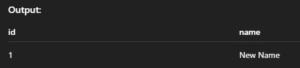
14. REPLACE INTO – Insert or Replace Row

Inserts a row or replaces the existing row with the same primary key.

Syntax:

REPLACE INTO table_name (column1, column2, ...) VALUES (value1, value2, ...);

Example:

REPLACE INTO students (id, name) VALUES (1, 'New Name');

Output: 

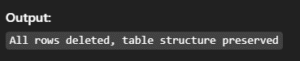
15. TRUNCATE – Delete All Data (Preserve Table)

Removes all rows from a table quickly but keeps its structure.

Syntax:

TRUNCATE TABLE table_name;

Example:

TRUNCATE TABLE students;

Output: 

16. SELECT INTO OUTFILE – Export Query Result to File

Saves the result of a SELECT query into a file on the server.

Syntax:

SELECT * FROM table_name INTO OUTFILE '/path/to/file.csv';

Example:

SELECT * FROM students INTO OUTFILE '/tmp/students.csv';

Output: 

17. LOAD DATA INFILE – Import Data from File

Loads data from a file directly into a MySQL table.

Syntax:

LOAD DATA INFILE '/path/to/file.csv' INTO TABLE table_name
FIELDS TERMINATED BY ',' ENCLOSED BY '"' LINES TERMINATED BY 'n';

Example:

LOAD DATA INFILE '/tmp/students.csv' INTO TABLE students;

Output: