Launch your tech mastery with us—your coding journey starts now!
Course Content
MySQL Tutorial
Welcome to the MySQL tutorial — crafted for everyone, whether you're taking your first steps into the world of databases or you're a developer looking to refine your skills with advanced MySQL techniques. From understanding the fundamentals of relational data to mastering complex SQL queries, transactions, stored procedures, and performance tuning — this guide has you covered.
0/6
MySQL Environmental Setup
Setting up MySQL is the first step toward working with relational databases. Below is a complete guide to help you install and run MySQL on your system, whether you are using Windows, Linux, or macOS. The second step is to start and stop MySQL service on your system. This ensures the MySQL server is running and ready to accept connections and execute queries.
0/2
MySQL Basics
SQL (Structured Query Language) is the standard language used to communicate with relational databases like MySQL. It allows you to create, modify, manage, and retrieve data from tables using simple and powerful commands.
0/5
MySQL Crud Operations
CRUD stands for Create, Read, Update, and Delete — the basic operations you perform on data in any MySQL database. These operations allow you to insert new records, retrieve data, update existing values, and remove records when needed.
0/1
MySQL Joins
In MySQL, JOINs are used to combine rows from two or more tables based on related columns. They are essential when your data is spread across multiple tables and you need to bring it together in one query result.
0/1
Stored Procedures & Functions in MySQL
This section explains the concepts of stored procedures and user-defined functions (UDFs) in MySQL, covering their creation, usage, parameters, differences, control flow, determinism, and advanced behavior — nothing is skipped.
0/6
MySQL Triggers
This section covers everything about Triggers and Events in MySQL — including what they are, how they work, when to use them, all the types available, and how to manage them. Each point comes with simple explanations and examples.
0/4
User Management and Security in MySQL
Managing users and securing your MySQL server is essential to control access, protect data, and prevent unauthorized operations. MySQL provides powerful tools to handle users, assign roles, and enforce fine-grained access control using privileges.
0/2
MySQL Performance Tuning
MySQL Performance Tuning is the process of optimizing how your database server, queries, indexes, and schema work together to provide the fastest and most resource-efficient responses. When a database starts to slow down under load, tuning ensures better speed, reduced CPU/memory usage, and quicker access to data — especially for high-traffic applications or large datasets. It involves query optimization, proper indexing, schema design, and server-level configurations that reduce delays and improve efficiency across all operations.
0/8
Query Optimization Techniques in MySQL
Query optimization is the process of writing SQL queries in a way that minimizes execution time and resource usage (like CPU, memory, and disk I/O). MySQL’s optimizer decides the best way to execute your SQL query, but your query structure can drastically impact performance. By following smart query practices, using indexes, avoiding expensive operations, and understanding how MySQL executes your statements, you can dramatically boost your database performance.
0/1
Replication in MySQL
0/1
MySQL

1. Use SELECT with Specific Columns Instead of SELECT *

SELECT * fetches all columns, even unused ones, increasing memory and bandwidth usage.

General Syntax:

SELECT column1, column2 FROM table_name;

1. Example:

a. For particular column:- 

SELECT name, age FROM students;

Output:-

b. To display every columns:- 

SELECT * FROM students;

Output:-

 

2. Use WHERE Clause to Filter Early

Use WHERE to reduce the number of rows MySQL needs to work with. The earlier you filter data, the faster other operations (like JOINs or GROUP BY) will be.

General Syntax:

SELECT columns FROM table_name WHERE condition;

Sample table:-
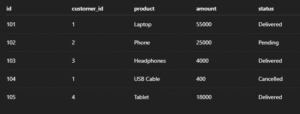
Example:

SELECT * FROM orders WHERE status = ‘Delivered’;

Output:-

3. Avoid Complex Subqueries — Use JOINs Where Possible

JOINs are often faster than subqueries, especially when indexing is used. Subqueries can result in temporary tables and higher memory usage.

General Syntax (JOIN):

SELECT columns FROM table1

JOIN table2 ON table1.column = table2.column;

Sample table:-
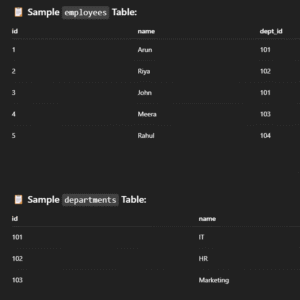
Example (Join):

SELECT employees.name, departments.name

FROM employees

JOIN departments ON employees.dept_id = departments.id;

Output:-

4. Use LIMIT for Pagination and Sampling

LIMIT reduces load by returning only a subset of rows. This is very useful in dashboards, reports, or lazy-loading systems.

General Syntax:

SELECT columns FROM table_name LIMIT count OFFSET start;

Sample table:-
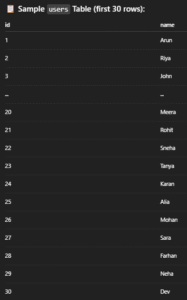
Example:

SELECT name FROM users LIMIT 10 OFFSET 20;

Output:-

( This fetches 10 records starting from the 21st row. )

5. Optimize ORDER BY and GROUP BY

Use ORDER BY and GROUP BY on indexed columns to avoid temporary files and table scans.

General Syntax:

SELECT columns FROM table_name ORDER BY column [ASC|DESC];

SELECT column, COUNT(*) FROM table_name GROUP BY column;

Sample Employee Table:-
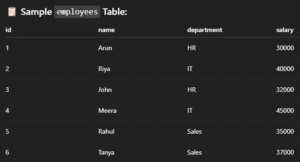
 

a. GROUP BY with COUNT Example:

SELECT department, COUNT(*) FROM employees GROUP BY department;

Output:-

b. ORDER BY with DESC Example:-

SELECT name, salary FROM employees ORDER BY salary DESC;

Output:-

6. Use Covering Indexes

A covering index includes all the columns needed for the query, so MySQL doesn’t need to fetch data from the table itself.

General Syntax (index creation):

CREATE INDEX idx_col1_col2 ON table_name(col1, col2);

Sample student table:-

Example:
SELECT name, age FROM students WHERE grade = ‘A’;

Output:-

7. Avoid Wildcards at the Start of LIKE Patterns

Using % at the beginning prevents index usage and causes full table scans.

Sample Table:-
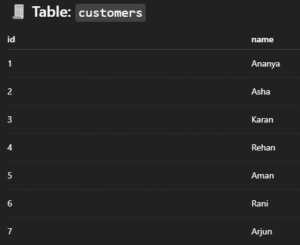
a. Uses Index:-

SELECT name FROM customers WHERE name LIKE ‘A%’;  

Output:-

b. No use of Index:-

SELECT name FROM customers WHERE name LIKE ‘%an’;  

Output:-

8. Optimize IN and OR Clauses

Use indexed columns in IN and OR, or rewrite using UNION if performance drops.

Example:-

SELECT * FROM students WHERE id IN (1, 2, 3);

Alternative using UNION:-

SELECT * FROM students WHERE id = 1

UNION

SELECT * FROM students WHERE id = 2

UNION

SELECT * FROM students WHERE id = 3;

Output:-

(The output would be same for both using IN or UNION)

9. Analyze Queries with EXPLAIN or ANALYZE

Syntax:

EXPLAIN SELECT …;

In MySQL 8.0+:

ANALYZE FORMAT=TRADITIONAL SELECT …;

( This shows row estimates, type of scans, index usage, cost, etc., helping you rewrite slow queries. )