
Types of Linked Lists
Depending on how the nodes are connected, linked lists are classified into three types:
A. Singly Linked List
A Singly Linked List is the simplest type of linked list. In this structure, each node contains data and a reference (pointer) to the next node in the sequence. The last node points to null, indicating the end of the list. 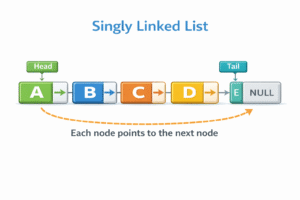
Key Characteristics:
- Unidirectional: You can only traverse the list in one direction (Head $\to$ Tail). You cannot go back to the previous node.
- Memory Efficient: It requires less memory per node compared to a doubly linked list because it only stores one pointer.
Code Node Structure
As seen in your Stack implementation, the node for a singly linked list is defined with just data and next : class Node {
int data;
Node next; // Reference to the next node
public Node(int data) {
this.data = data;
this.next = null; // Ends with null by default
}
}
class Node:

    def __init__(self, data):
        self.data = data
        self.next = None  # Reference to the next node
#include <stdio.h>
#include <stdlib.h>

struct Node {
    int data;
    struct Node* next; // Reference to the next node
};

struct Node* createNode(int data) {

    struct Node* newNode = (struct Node*)malloc(sizeof(struct Node));

    newNode->data = data;
    newNode->next = NULL; // Ends with NULL by default

    return newNode;
}
#include <iostream>
using namespace std;

class Node {

public:
    int data;
    Node* next; // Reference to the next node

    Node(int data) {
        this->data = data;
        this->next = NULL; // Ends with null by default
    }
};
- Navigation: Forward only.
- Memory: Uses less memory (only one pointer per node).
- Analogy: A conga line where everyone holds the waist of the person in front.
B. Doubly Linked List
A Doubly Linked List is a more complex structure where each node contains three parts instead of two. It allows traversal in both directions.
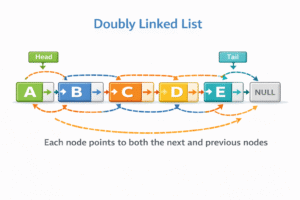
Node Architecture:
- Prev: A pointer to the previous node.
- Data: The value stored.
- Next: A pointer to the next node.
Code Implementation
The Node class expands to include the prev pointer. class DoublyNode {
int data;
DoublyNode next;
DoublyNode prev; // New pointer for backward navigation
public DoublyNode(int data) {
this.data = data;
this.next = null;
this.prev = null;
}
}
public class DoublyLinkedList {
DoublyNode head;
// Insert at the beginning
public void push(int data) {
DoublyNode newNode = new DoublyNode(data);
newNode.next = head; // 1. New node points to current head
newNode.prev = null; // 2. New node's prev is null (it's new head)
if (head != null) {
head.prev = newNode; // 3. Old head's prev points to new node
}
head = newNode; // 4. Update head
}
}
class DoublyNode:

    def __init__(self, data):
        self.data = data
        self.next = None
        self.prev = None  # Pointer for backward navigation


class DoublyLinkedList:

    def __init__(self):
        self.head = None


    # Insert at the beginning
    def push(self, data):

        newNode = DoublyNode(data)

        newNode.next = self.head   # 1. New node points to current head
        newNode.prev = None        # 2. New node's prev is None

        if self.head is not None:
            self.head.prev = newNode  # 3. Old head's prev points to new node

        self.head = newNode  # 4. Update head
#include <stdio.h>
#include <stdlib.h>

struct DoublyNode {
    int data;
    struct DoublyNode* next;
    struct DoublyNode* prev; // Pointer for backward navigation
};

struct DoublyNode* head = NULL;


// Insert at the beginning
void push(int data) {

    struct DoublyNode* newNode = (struct DoublyNode*)malloc(sizeof(struct DoublyNode));

    newNode->data = data;

    newNode->next = head; // 1. New node points to current head
    newNode->prev = NULL; // 2. New node's prev is NULL

    if (head != NULL) {
        head->prev = newNode; // 3. Old head's prev points to new node
    }

    head = newNode; // 4. Update head
}
#include <iostream>
using namespace std;

class DoublyNode {

public:
    int data;
    DoublyNode* next;
    DoublyNode* prev; // Pointer for backward navigation

    DoublyNode(int data) {
        this->data = data;
        this->next = NULL;
        this->prev = NULL;
    }
};


class DoublyLinkedList {

public:
    DoublyNode* head;

    DoublyLinkedList() {
        head = NULL;
    }

    // Insert at the beginning
    void push(int data) {

        DoublyNode* newNode = new DoublyNode(data);

        newNode->next = head; // 1. New node points to current head
        newNode->prev = NULL; // 2. New node's prev is NULL

        if (head != NULL) {
            head->prev = newNode; // 3. Old head's prev points to new node
        }

        head = newNode; // 4. Update head
    }
};
Advantages vs. Disadvantages
- Pros: Can traverse both ways. Deletion is easier because you have access to the previous node immediately.
- Cons: Consumes more memory (extra pointer). Code is slightly more complex to maintain (must update two pointers for every insertion/deletion).
Real-Life Analogy
Web Browser History: You can click “Back” to go to the previous page (prev pointer) or “Forward” to go to the next page (next pointer). The browser maintains a link in both directions.
C. Circular Linked List
A Circular Linked List is a variation where the list has no end. The last node’s next pointer, instead of pointing to null, points back to the Head (first node). This forms a continuous loop. 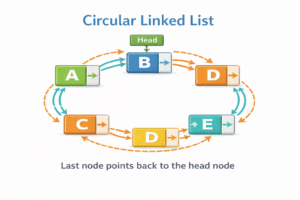
Types of Circular Lists:
- Circular Singly Linked List: Simple nodes, but the tail connects to the head.
- Circular Doubly Linked List: Doubly nodes, where tail connects to head and head connects to tail.
Code Logic (Singly Circular)
Notice that we never set next to null.public class CircularLinkedList {
Node head = null;
Node tail = null;
public void add(int data) {
Node newNode = new Node(data);
if (head == null) {
// If list is empty, point head to new node
head = newNode;
tail = newNode;
newNode.next = head; // Point back to itself
} else {
// Standard insertion
tail.next = newNode; // Old tail points to new node
tail = newNode; // Update tail
tail.next = head; // **CRITICAL**: New tail points back to Head
}
}
// Traversal requires a do-while loop to avoid infinite loops
public void display() {
if (head == null) return;
Node current = head;
do {
System.out.print(current.data + " -> ");
current = current.next;
} while (current != head); // Stop when we return to start
System.out.println("(Head)");
}
}
class Node:
    def __init__(self, data):
        self.data = data
        self.next = None


class CircularLinkedList:

    def __init__(self):
        self.head = None
        self.tail = None


    def add(self, data):

        newNode = Node(data)

        if self.head is None:
            # If list is empty
            self.head = newNode
            self.tail = newNode
            newNode.next = self.head  # Point back to itself

        else:
            # Standard insertion
            self.tail.next = newNode
            self.tail = newNode
            self.tail.next = self.head  # New tail points back to head


    def display(self):

        if self.head is None:
            return

        current = self.head

        while True:
            print(current.data, "->", end=" ")
            current = current.next
            if current == self.head:
                break

        print("(Head)")
#include <stdio.h>
#include <stdlib.h>

struct Node {
    int data;
    struct Node* next;
};

struct Node* head = NULL;
struct Node* tail = NULL;


void add(int data) {

    struct Node* newNode = (struct Node*)malloc(sizeof(struct Node));
    newNode->data = data;

    if (head == NULL) {
        // If list is empty
        head = newNode;
        tail = newNode;
        newNode->next = head;
    }

    else {
        tail->next = newNode;
        tail = newNode;
        tail->next = head;
    }
}


void display() {

    if (head == NULL) return;

    struct Node* current = head;

    do {
        printf("%d -> ", current->data);
        current = current->next;
    } while (current != head);

    printf("(Head)\n");
}
#include <iostream>
using namespace std;

class Node {

public:
    int data;
    Node* next;

    Node(int data) {
        this->data = data;
        this->next = NULL;
    }
};


class CircularLinkedList {

public:
    Node* head = NULL;
    Node* tail = NULL;


    void add(int data) {

        Node* newNode = new Node(data);

        if (head == NULL) {
            // If list is empty
            head = newNode;
            tail = newNode;
            newNode->next = head;
        }

        else {
            tail->next = newNode;
            tail = newNode;
            tail->next = head;
        }
    }


    void display() {

        if (head == NULL) return;

        Node* current = head;

        do {
            cout << current->data << " -> ";
            current = current->next;
        } while (current != head);

        cout << "(Head)" << endl;
    }
};
Real-Life Analogy
- Monopoly Board Game: The board is a continuous loop. After the last space (Boardwalk), you move right back to the first space (Go).
- Music Playlist (Repeat All): When the last song finishes, the player automatically starts the first song again.
Comparison Table for Your Course
| Feature | Singly Linked List | Doubly Linked List | Circular Linked List |
| Direction | Forward Only | Forward & Backward | Forward (Loops back) |
| Memory | Low (1 pointer) | High (2 pointers) | Low (1 pointer) |
| Insertion | Fast | Moderate (more pointers to update) | Fast |
| End of List | Points to null | Points to null | Points to Head |
| Best Use | Simple stacks/queues | Music players, Undo/Redo | CPU Scheduling, Games |