
Trie (Prefix Tree)
Definition
A Trie (pronounced “try”) is a tree-like data structure used efficiently for storing strings. Each node represents a character of a string.
How it Works
Instead of storing a whole word like “Apple” in one node, a Trie breaks it down.
- The root is empty.
- The first child is ‘A’.
- The child of ‘A’ is ‘p’, and so on.
- Words with common prefixes (like “Car” and “Cat”) share the same initial path (‘C’ rightarrow ‘a’).
Real-World Analogy:
Think of auto-complete on your phone. When you type “H-E-L”, the phone looks down the path of those specific letters to suggest “Hello” or “Help”. It doesn’t look at words starting with ‘Z’.
Example
Insert: “CAT”, “CAR”
Structure:
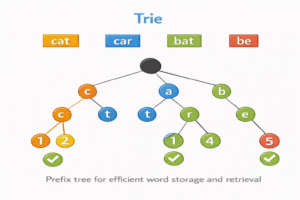
Both words share the ‘C-A’ path.
Code Example
PythonJavaCC++
# Trie Node
class TrieNode:

    def __init__(self):
        self.children = {}
        self.is_end_of_word = False


class Trie:

    def __init__(self):
        self.root = TrieNode()

    # Insert word into Trie
    def insert(self, word):

        node = self.root

        for char in word:

            if char not in node.children:
                node.children[char] = TrieNode()

            node = node.children[char]

        node.is_end_of_word = True


    # Search word
    def search(self, word):

        node = self.root

        for char in word:

            if char not in node.children:
                return False

            node = node.children[char]

        return node.is_end_of_word
import java.util.HashMap;

class TrieNode {

    HashMap<Character, TrieNode> children = new HashMap<>();
    boolean isEndOfWord = false;
}

class Trie {

    TrieNode root = new TrieNode();

    // Insert word
    void insert(String word) {

        TrieNode node = root;

        for (char ch : word.toCharArray()) {

            node.children.putIfAbsent(ch, new TrieNode());

            node = node.children.get(ch);
        }

        node.isEndOfWord = true;
    }

    // Search word
    boolean search(String word) {

        TrieNode node = root;

        for (char ch : word.toCharArray()) {

            if (!node.children.containsKey(ch))
                return false;

            node = node.children.get(ch);
        }

        return node.isEndOfWord;
    }
}
#include <stdio.h>
#include <stdlib.h>

#define ALPHABET_SIZE 26

// Trie Node
struct TrieNode {

    struct TrieNode* children[ALPHABET_SIZE];
    int isEndOfWord;
};


// Create node
struct TrieNode* createNode() {

    struct TrieNode* node =
        (struct TrieNode*)malloc(sizeof(struct TrieNode));

    node->isEndOfWord = 0;

    for (int i = 0; i < ALPHABET_SIZE; i++)
        node->children[i] = NULL;

    return node;
}


// Insert word
void insert(struct TrieNode* root, char* word) {

    struct TrieNode* node = root;

    for (int i = 0; word[i] != '\0'; i++) {

        int index = word[i] - 'a';

        if (!node->children[index])
            node->children[index] = createNode();

        node = node->children[index];
    }

    node->isEndOfWord = 1;
}


// Search word
int search(struct TrieNode* root, char* word) {

    struct TrieNode* node = root;

    for (int i = 0; word[i] != '\0'; i++) {

        int index = word[i] - 'a';

        if (!node->children[index])
            return 0;

        node = node->children[index];
    }

    return node->isEndOfWord;
}
#include <iostream>
#include <unordered_map>
using namespace std;

class TrieNode {

public:
    unordered_map<char, TrieNode*> children;
    bool isEndOfWord = false;
};

class Trie {

public:
    TrieNode* root;

    Trie() {
        root = new TrieNode();
    }

    // Insert word
    void insert(string word) {

        TrieNode* node = root;

        for (char ch : word) {

            if (node->children.count(ch) == 0)
                node->children[ch] = new TrieNode();

            node = node->children[ch];
        }

        node->isEndOfWord = true;
    }

    // Search word
    bool search(string word) {

        TrieNode* node = root;

        for (char ch : word) {

            if (node->children.count(ch) == 0)
                return false;

            node = node->children[ch];
        }

        return node->isEndOfWord;
    }
};
Complexity Analysis
- Time Complexity: O(L) where L is the length of the word. Searching for a word depends only on the word’s length, not the size of the database!
- Space Complexity: O(N times L) in worst case, but saves space when many words share prefixes.
Use Cases
- Autocomplete/Typeahead: Google search suggestions.
- Spell Checkers: Validating if a word exists in the dictionary.
- IP Routing: Longest prefix matching in internet routers.