
Topological Sort
Definition
Topological Sort is a linear ordering of vertices in a Directed Acyclic Graph (DAG). The rule is simple: For every directed edge from vertex U to vertex V, vertex U must come before vertex V in the ordering.
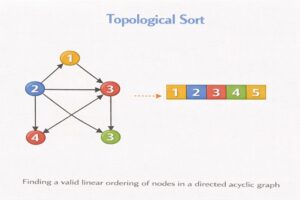
Note: This only works if the graph has NO cycles. If there is a cycle (A needs B, B needs A), you cannot sort them.
How it Works
Think of this as a To-Do List with Prerequisites.
- Find a task that has zero prerequisites (no arrows pointing to it).
- “Do” that task (add to sorted list).
- Cross it off. Now, look at the tasks that were waiting for it. If any of them now have zero remaining prerequisites, they are ready to be done next.
- Repeat.
Real-World Analogy
University Course Prerequisites:
- You cannot take Calculus II until you pass Calculus I.
- You cannot take Physics until you pass Calculus I.
- Topological Sort: Calculus I $\rightarrow$ Physics $\rightarrow$ Calculus II. (This is a valid valid order because dependencies are respected).
Example
Dependencies:
- A rightarrow C
- B rightarrow C
- C rightarrow D
Valid Sort: A, B, C, D OR B, A, C, D. (A and B have no dependencies, so either can go first. But C must wait for both, and D must wait for C).
Code Example (Kahn’s Algorithm – BFS Approach)
PythonJavaCC++
from collections import deque

# Topological Sort using Kahn's Algorithm
def topological_sort(vertices, edges):

    # Create graph and indegree array
    graph = {i: [] for i in range(vertices)}
    indegree = {i: 0 for i in range(vertices)}

    for u, v in edges:
        graph[u].append(v)
        indegree[v] += 1

    # Queue for nodes with indegree 0
    queue = deque([node for node in indegree if indegree[node] == 0])
    result = []

    while queue:

        node = queue.popleft()
        result.append(node)

        for neighbor in graph[node]:

            indegree[neighbor] -= 1

            if indegree[neighbor] == 0:
                queue.append(neighbor)

    # Cycle detection
    if len(result) != vertices:
        return "Graph has a cycle! Cannot Sort."

    return result


# Example
edges = [(0,2), (1,2), (2,3)]

print("Topological Sort:", topological_sort(4, edges))
import java.util.*;

public class TopologicalSort {

    static List<Integer> topoSort(int vertices, int[][] edges) {

        List<List<Integer>> graph = new ArrayList<>();
        int[] indegree = new int[vertices];

        for (int i = 0; i < vertices; i++)
            graph.add(new ArrayList<>());

        for (int[] e : edges) {

            graph.get(e[0]).add(e[1]);
            indegree[e[1]]++;
        }

        Queue<Integer> q = new LinkedList<>();

        for (int i = 0; i < vertices; i++)
            if (indegree[i] == 0)
                q.add(i);

        List<Integer> result = new ArrayList<>();

        while (!q.isEmpty()) {

            int node = q.poll();
            result.add(node);

            for (int neighbor : graph.get(node)) {

                indegree[neighbor]--;

                if (indegree[neighbor] == 0)
                    q.add(neighbor);
            }
        }

        if (result.size() != vertices)
            System.out.println("Graph has a cycle!");

        return result;
    }

    public static void main(String[] args) {

        int[][] edges = {{0,2},{1,2},{2,3}};

        System.out.println("Topological Sort: " +
                topoSort(4, edges));
    }
}
#include <stdio.h>

#define V 4

int graph[V][V] = {0};

void addEdge(int u, int v) {
    graph[u][v] = 1;
}

void topologicalSort() {

    int indegree[V] = {0};

    for (int i = 0; i < V; i++)
        for (int j = 0; j < V; j++)
            if (graph[i][j])
                indegree[j]++;

    int queue[V], front = 0, rear = 0;

    for (int i = 0; i < V; i++)
        if (indegree[i] == 0)
            queue[rear++] = i;

    while (front < rear) {

        int node = queue[front++];

        printf("%d ", node);

        for (int i = 0; i < V; i++) {

            if (graph[node][i]) {

                indegree[i]--;

                if (indegree[i] == 0)
                    queue[rear++] = i;
            }
        }
    }
}

int main() {

    addEdge(0,2);
    addEdge(1,2);
    addEdge(2,3);

    printf("Topological Sort:\n");

    topologicalSort();

    return 0;
}
#include <iostream>
#include <vector>
#include <queue>
using namespace std;

vector<int> topoSort(int V, vector<pair<int,int>> edges) {

    vector<vector<int>> graph(V);
    vector<int> indegree(V,0);

    for (auto e : edges) {

        graph[e.first].push_back(e.second);
        indegree[e.second]++;
    }

    queue<int> q;

    for (int i = 0; i < V; i++)
        if (indegree[i] == 0)
            q.push(i);

    vector<int> result;

    while (!q.empty()) {

        int node = q.front();
        q.pop();

        result.push_back(node);

        for (int neighbor : graph[node]) {

            indegree[neighbor]--;

            if (indegree[neighbor] == 0)
                q.push(neighbor);
        }
    }

    return result;
}

int main() {

    vector<pair<int,int>> edges = {
        {0,2},{1,2},{2,3}
    };

    vector<int> result = topoSort(4, edges);

    cout << "Topological Sort: ";

    for (int x : result)
        cout << x << " ";

    return 0;
}
Complexity Analysis
- Time Complexity: O(V + E). We process every node and every edge exactly once.
- Space Complexity: O(V). We need an array for Indegrees and a Queue.
Use Cases & Interview Relevance
- Build Systems (Makefiles/Maven/Gradle): Determining which files to compile first. If File B imports File A, A must be compiled first.
- Task Scheduling: Operating systems scheduling jobs that depend on each other.
- React/Frontend Initialization: Deciding the order to load components or scripts.
- Interview Tip: If a question mentions “prerequisites,” “dependencies,” or “ordering tasks,” it is almost 100% a Topological Sort question.