
String Operations
Because Strings are immutable, simple operations can be costly if done incorrectly. Here is how to handle them. 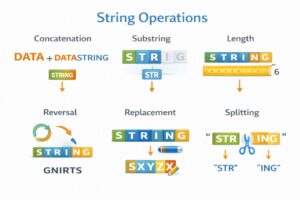
Common Operations:
- Concatenation: Joining two strings together.
- Substring: Extracting a portion of a string.
- Length: Counting the number of characters.
- Searching: Finding the index of a specific character or pattern.
Code Implementation: String Methods
JavaPythonCC++
public class StringBasics {
    public static void main(String[] args) {
        // 1. Creation
        String str1 = "Hello";              // String Literal (Stored in Pool)
        String str2 = new String("World");  // String Object (Stored in Heap)

        // 2. Concatenation
        String result = str1 + " " + str2;
        System.out.println(result); // Output: Hello World

        // 3. Length (O(1))
        System.out.println("Length: " + result.length()); // Output: 11

        // 4. CharAt (Accessing character at index - O(1))
        System.out.println("Char at index 1: " + str1.charAt(1)); // Output: e

        // 5. Substring (Extracting part - O(n))
        // substring(start, end) -> includes start, excludes end
        System.out.println("Substring: " + result.substring(0, 5)); // Output: Hello

        // 6. Equality Check (Critical in Java!)
        // ALWAYS use .equals(), NEVER use == for strings
        System.out.println(str1.equals("Hello")); // true
    }
}
# String Basics

# 1. Creation
str1 = "Hello"
str2 = "World"

# 2. Concatenation
result = str1 + " " + str2
print(result)  # Output: Hello World

# 3. Length
print("Length:", len(result))  # Output: 11

# 4. Access character at index
print("Char at index 1:", str1[1])  # Output: e

# 5. Substring (Slicing)
# includes start, excludes end
print("Substring:", result[0:5])  # Output: Hello

# 6. Equality Check
print(str1 == "Hello")  # True
#include <stdio.h>
#include <string.h>

int main() {

    // 1. Creation
    char str1[] = "Hello";
    char str2[] = "World";

    // 2. Concatenation
    char result[20];
    strcpy(result, str1);
    strcat(result, " ");
    strcat(result, str2);

    printf("%s\n", result); // Output: Hello World

    // 3. Length
    printf("Length: %lu\n", strlen(result));

    // 4. Access character at index
    printf("Char at index 1: %c\n", str1[1]);

    // 5. Substring
    char substring[6];
    strncpy(substring, result, 5);
    substring[5] = '\0';
    printf("Substring: %s\n", substring);

    // 6. Equality Check
    printf("%s\n", strcmp(str1, "Hello") == 0 ? "true" : "false");

    return 0;
}
#include <iostream>
#include <string>
using namespace std;

int main() {

    // 1. Creation
    string str1 = "Hello";
    string str2 = "World";

    // 2. Concatenation
    string result = str1 + " " + str2;
    cout << result << endl; // Output: Hello World

    // 3. Length
    cout << "Length: " << result.length() << endl;

    // 4. Access character at index
    cout << "Char at index 1: " << str1[1] << endl;

    // 5. Substring
    cout << "Substring: " << result.substr(0, 5) << endl;

    // 6. Equality Check
    cout << (str1 == "Hello") << endl;

    return 0;
}