
Priority Queue
A Priority Queue is a special type of queue where each element has a priority. Elements with higher priority are served before elements with lower priority. In Java, we can use the built-in PriorityQueue class. By default, it implements a Min-Heap (smallest element is processed first). 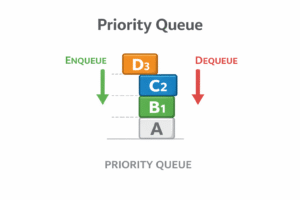 Code Example
JavaPythonCC++
import java.util.PriorityQueue;

public class PriorityQueueDemo {
    public static void main(String[] args) {
        // Min Heap (Default behavior)
        PriorityQueue<Integer> minHeap = new PriorityQueue<>();

        minHeap.add(30);
        minHeap.add(10);
        minHeap.add(20);

        System.out.println("Processing Min Heap:");
        while (!minHeap.isEmpty()) {
            // poll() removes the head of the queue (smallest element)
            System.out.println(minHeap.poll());
        }
        // Output: 10, 20, 30

        // Max Heap (Custom Comparator)
        PriorityQueue<Integer> maxHeap = new PriorityQueue<>((a, b) -> b - a);

        maxHeap.add(30);
        maxHeap.add(10);
        maxHeap.add(20);

        System.out.println("\nProcessing Max Heap:");
        while (!maxHeap.isEmpty()) {
            System.out.println(maxHeap.poll());
        }
        // Output: 30, 20, 10
    }
}
import heapq

# Min Heap (Default behavior)
minHeap = []

heapq.heappush(minHeap, 30)
heapq.heappush(minHeap, 10)
heapq.heappush(minHeap, 20)

print("Processing Min Heap:")
while minHeap:
    print(heapq.heappop(minHeap))
# Output: 10, 20, 30


# Max Heap (Using negative values)
maxHeap = []

heapq.heappush(maxHeap, -30)
heapq.heappush(maxHeap, -10)
heapq.heappush(maxHeap, -20)

print("\nProcessing Max Heap:")
while maxHeap:
    print(-heapq.heappop(maxHeap))
# Output: 30, 20, 10
#include <stdio.h>
#include <stdlib.h>

#define SIZE 100

int heap[SIZE];
int n = 0;


// Insert into Min Heap
void insert(int value) {

    int i = n++;
    heap[i] = value;

    while (i != 0 && heap[(i - 1) / 2] > heap[i]) {
        int temp = heap[i];
        heap[i] = heap[(i - 1) / 2];
        heap[(i - 1) / 2] = temp;
        i = (i - 1) / 2;
    }
}


// Extract Min
int extractMin() {

    if (n <= 0) return -1;

    int root = heap[0];
    heap[0] = heap[--n];

    int i = 0;

    while (1) {

        int left = 2 * i + 1;
        int right = 2 * i + 2;
        int smallest = i;

        if (left < n && heap[left] < heap[smallest])
            smallest = left;

        if (right < n && heap[right]  0) {
        printf("%d\n", extractMin());
    }

    return 0;
}
#include <iostream>
#include <queue>
using namespace std;

int main() {

    // Min Heap (Default behavior)
    priority_queue<int, vector<int>, greater<int>> minHeap;

    minHeap.push(30);
    minHeap.push(10);
    minHeap.push(20);

    cout << "Processing Min Heap:" << endl;

    while (!minHeap.empty()) {
        cout << minHeap.top() << endl;
        minHeap.pop();
    }


    // Max Heap
    priority_queue<int> maxHeap;

    maxHeap.push(30);
    maxHeap.push(10);
    maxHeap.push(20);

    cout << "\nProcessing Max Heap:" << endl;

    while (!maxHeap.empty()) {
        cout << maxHeap.top() << endl;
        maxHeap.pop();
    }

    return 0;
}