
Order of Growth (Best to Worst)
When analyzing algorithms, the overall efficiency is determined by the highest power of n, which dictates the function type. The mathematical order of growth from most efficient to least efficient is:
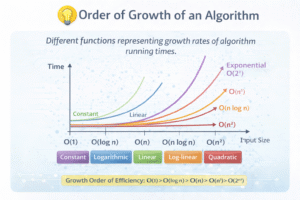
O(1) < O(\log n) < O(n) < O(n \log n) < O(n^2) < O(n^3) < O(2^n) < O(n!)
1. Constant Function
-
Time Complexity: O(1)
-
Mathematical Form: f(n) = c
-
Meaning: The execution time is entirely independent of the input size.
-
Algorithm Example: Printing the first element of an array, such as
print A[1]. This requires one array access and one print operation, resulting in constant steps.
2. Logarithmic Function
-
Time Complexity: O(log n)
-
Mathematical Form: f(n) = log n
-
Meaning: The input size reduces by a constant factor during each step of the execution.
-
Algorithm Example: Binary Search. For an input of n = 16, the search space halves progressively: 16 ->8 ->4 ->2 ->1 (taking 4 steps).
3. Linear Function
-
Time Complexity: O(n)
-
Mathematical Form: f(n) = n
-
Meaning: The execution time increases directly proportional to the input size.
-
Algorithm Example: A single
forloop running from 1 to n. If n = 100, the loop runs exactly 100 times.
4. Linearithmic Function
-
Time Complexity: O(n log n)
-
Mathematical Form: f(n) = n log n
-
Meaning: This is a combination of linear work and logarithmic division.
-
Algorithm Example: Merge Sort. If n = 8, the calculation is 8 log_2 8 = 8*3 = 24 operations.
5. Quadratic Function
-
Time Complexity: O(n^2)
-
Mathematical Form: f(n) = n^2
-
Meaning: This typically occurs when an algorithm contains two nested loops.
-
Algorithm Example: Two
forloops iterating from 1 to n. If n = 5, the number of operations is 5*5 = 25.
6. Cubic Function
-
Time Complexity: O(n^3)
-
Mathematical Form: f(n) = n^3
-
Meaning: This occurs when an algorithm relies on three nested loops.
-
Algorithm Example: Three
forloops iterating from 1 to n. If n = 4, the operations total 4^3 = 64.
7. Polynomial Function
-
Mathematical Form: f(n) = n^k \quad (k \ge 1)
-
Meaning: This is a broader category that includes linear, quadratic, cubic, etc. Algorithms falling into this category are generally considered “efficient and solvable” in computer science.
-
Example: If f(n) = n^4 + n^2 + 10, it simplifies to an order of O(n^4).
8. Exponential Function
-
Time Complexity: O(2^n)
-
Mathematical Form: f(n) = 2^n
-
Meaning: The execution time doubles for every single increment in n.
-
Algorithm Example: A naive recursive Fibonacci sequence calculator. For n = 5, it takes 2^5 = 32 operations.
9. Factorial Function
-
Time Complexity: O(n!)
-
Mathematical Form: f(n) = n!
-
Meaning: This represents extremely slow growth and usually occurs when an algorithm tries all possible permutations of an input.
-
Algorithm Example: Solving the Traveling Salesman Problem using a brute-force approach. For just n = 5, the operations jump to 5! [cite_start]= 120.
10. Composite / Mixed Function
-
Mathematical Form: Equations mixing multiple terms, such as f(n) = n^2 + 5n + 20.
-
Simplification: When analyzing these, you drop the lower-order terms and constants, simplifying it to its highest degree, which in this case is O(n^2).