
Min Heap
Definition
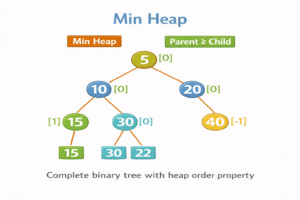
A Min Heap is the exact opposite of a Max Heap. In a Min Heap, the value of every parent node is less than or equal to the values of its children. The smallest number is always at the root.
How it Works
- The Rule: Every parent must be smaller than its children.
- The Root: The top-most element is always the absolute minimum value in the entire dataset.
Example
Input Numbers: [10, 20, 15, 30, 40]
Min Heap Structure:
10
/ \
20 15
/ \
30 40
Notice that 10 is smaller than 20 and 15. 20 is smaller than 30 and 40.
Code Example
PythonJavaCC++
import heapq

# Python's default heap implementation is a Min Heap
min_heap = []
numbers = [40, 30, 15, 10, 20]

# Build the heap
for num in numbers:
    heapq.heappush(min_heap, num)

# The smallest element is always at index 0
print("Smallest value:", min_heap[0])  # Output: 10

# Remove the smallest element
smallest = heapq.heappop(min_heap)
print("Removed:", smallest)  # Output: 10
import java.util.PriorityQueue;

public class MinHeapExample {

    public static void main(String[] args) {

        // Java PriorityQueue default = Min Heap
        PriorityQueue<Integer> minHeap = new PriorityQueue<>();

        int[] numbers = {40, 30, 15, 10, 20};

        // Insert elements
        for (int num : numbers) {
            minHeap.add(num);
        }

        // Smallest element
        System.out.println("Smallest value: " + minHeap.peek()); // 10

        // Remove smallest element
        int smallest = minHeap.poll();
        System.out.println("Removed: " + smallest); // 10
    }
}
#include <stdio.h>

#define SIZE 100

int heap[SIZE];
int n = 0;

// Insert into Min Heap
void insert(int value) {

    int i = n++;
    heap[i] = value;

    // Heapify up
    while (i != 0 && heap[(i - 1) / 2] > heap[i]) {

        int temp = heap[i];
        heap[i] = heap[(i - 1) / 2];
        heap[(i - 1) / 2] = temp;

        i = (i - 1) / 2;
    }
}

// Remove smallest element
int extractMin() {

    int root = heap[0];
    heap[0] = heap[--n];

    int i = 0;

    while (1) {

        int left = 2 * i + 1;
        int right = 2 * i + 2;
        int smallest = i;

        if (left < n && heap[left] < heap[smallest])
            smallest = left;

        if (right < n && heap[right] < heap[smallest])
            smallest = right;

        if (smallest != i) {

            int temp = heap[i];
            heap[i] = heap[smallest];
            heap[smallest] = temp;

            i = smallest;
        }
        else
            break;
    }

    return root;
}

int main() {

    int numbers[] = {40,30,15,10,20};

    for (int i = 0; i < 5; i++)
        insert(numbers[i]);

    printf("Smallest value: %d\n", heap[0]);

    int smallest = extractMin();
    printf("Removed: %d\n", smallest);

    return 0;
}
#include <iostream>
#include <queue>
using namespace std;

int main() {

    // Min Heap in C++
    priority_queue<int, vector<int>, greater<int>> minHeap;

    int numbers[] = {40,30,15,10,20};

    for (int i = 0; i < 5; i++)
        minHeap.push(numbers[i]);

    cout << "Smallest value: " << minHeap.top() << endl;

    int smallest = minHeap.top();
    minHeap.pop();

    cout << "Removed: " << smallest << endl;

    return 0;
}
Use Cases
- Merging Sorted Arrays: Efficiently combining multiple sorted lists into one.
- Real-time Stream Data: Finding the median of a number stream dynamically.