
Introduction to Dynamic Programming (DP)
Definition
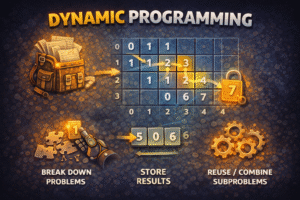
Dynamic Programming is a method for solving complex problems by breaking them down into simpler subproblems. It solves each subproblem only once and stores the result (usually in a table or array) to avoid re-computing it.
How it Works
Think of DP as “Recursion with a Notepad.”
- Break it Down: Take a big problem and split it into smaller pieces.
- Solve Once: Solve the first small piece.
- Memoize (Write it Down): Store the answer in your “notepad” (an array or hash map).
- Reuse: If you need that answer again later, don’t solve it again! Just look at your notepad.
Real-World Analogy
1 + 1 + 1 + 1 + 1…
- Question: What is 1+1+1+1+1?
- You: 5.
- Question: What if I add another +1 at the end?
- You: 6.
- Why was that fast? You didn’t recount the first five 1s. You remembered the previous sum (5) and just added 1. That’s Dynamic Programming.
Two Approaches
- Top-Down (Memoization): Start with the big problem and break it down. (Recursive)
- Bottom-Up (Tabulation): Start with the smallest subproblem and build up to the answer. (Iterative)