
Heaps (The Foundation)
Definition
A Heap is a special tree-based data structure that satisfies the “heap property.” Think of it as a binary tree (where each node has at most two children) that follows a specific rule regarding how numbers are organized.
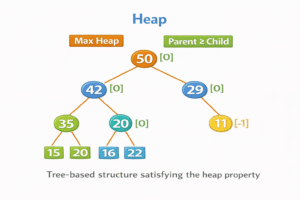
How it Works
Heaps are almost always Complete Binary Trees. This means the tree is completely filled on all levels except possibly the last, which is filled from left to right. This structure makes heaps incredibly efficient to implement using simple arrays, without needing complex pointer logic.
Real-World Analogy:
Imagine a corporate hierarchy. The CEO is at the top, followed by VPs, then Managers. In a “Heap” structure, the rule might be that a boss must always have a higher salary than their subordinates (Max Heap) or perhaps a lower employee ID number (Min Heap).
Complexity Analysis
- Access Max/Min: O(1) (Instant access to the root)
- Insertion: O(log n) (Depends on the height of the tree)
- Deletion: O(log n)
Use Cases
- Priority Queues: Used in operating systems to schedule tasks based on priority.
- Graph Algorithms: Essential for Dijkstra’s Shortest Path algorithm and Prim’s Minimum Spanning Tree algorithm.