
Graphs (The Big Picture)
Definition
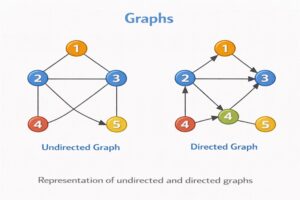
A Graph is a non-linear data structure used to represent connections between objects. It consists of two main parts: Nodes (also called Vertices, representing the objects) and Edges (the lines connecting the nodes).
How it Works
Think of a graph as a map.
- Vertices (V): Points on the map (e.g., cities).
- Edges (E): Roads connecting the cities.
Graphs can be Directed (one-way streets) or Undirected (two-way streets). They can also be Weighted (roads with distances) or Unweighted.
Real-World Analogy
Social Networks: On Facebook, you are a “Node.” If you are friends with someone, there is an “Edge” connecting you two. This is an undirected graph (friendship is mutual). On Twitter/X, if you follow a celebrity, that is a directed graph (you follow them, but they might not follow you).