
Fibonacci Series using DP
Definition
The Fibonacci Sequence is a series where each number is the sum of the two preceding ones: 0, 1, 1, 2, 3, 5, 8…
How it Works (The DP Way)
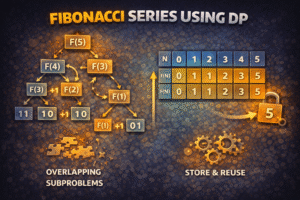
A normal recursive approach calculates fib(5) by calling fib(4) and fib(3). But fib(4) also calls fib(3). We end up calculating fib(3) twice!
- DP Fix: Calculate fib(3) once, save it in an array memo[3]. The next time it’s needed, just return memo[3].
Code Example (Top Down)
PythonJavaCC++
# Fibonacci using Dynamic Programming (Memoization)

memo = [-1] * 100

def fib(n):

    if n <= 1:
        return n

    # If value already computed
    if memo[n] != -1:
        return memo[n]

    # Compute and store
    memo[n] = fib(n - 1) + fib(n - 2)

    return memo[n]


print(fib(10))  # 55
import java.util.Arrays;

public class FibonacciDP {

    static int[] memo = new int[100];

    public static int fib(int n) {

        if (n <= 1)
            return n;

        if (memo[n] != -1)
            return memo[n];

        memo[n] = fib(n - 1) + fib(n - 2);

        return memo[n];
    }

    public static void main(String[] args) {

        Arrays.fill(memo, -1);

        System.out.println(fib(10)); // 55
    }
}
#include <stdio.h>

int memo[100];

int fib(int n) {

    if (n <= 1)
        return n;

    if (memo[n] != -1)
        return memo[n];

    memo[n] = fib(n - 1) + fib(n - 2);

    return memo[n];
}

int main() {

    for (int i = 0; i < 100; i++)
        memo[i] = -1;

    printf("%d\n", fib(10));  // 55

    return 0;
}
#include <iostream>
#include <vector>
using namespace std;

vector<int> memo(100, -1);

int fib(int n) {

    if (n <= 1)
        return n;

    if (memo[n] != -1)
        return memo[n];

    memo[n] = fib(n - 1) + fib(n - 2);

    return memo[n];
}

int main() {

    cout << fib(10);  // 55

    return 0;
}
Complexity Analysis
- Time Complexity: O(N). We calculate each number from 0 to N exactly once. (Naive recursion is O(2^N) terrible)
- Space Complexity: O(N) for the array and recursion stack.