
Fenwick Tree (Binary Indexed Tree)
Definition
A Fenwick Tree is a clever data structure that does exactly what a Segment Tree does (Prefix Sums and Updates) but uses less memory and is easier to code. It relies heavily on binary bit manipulation.
How it Works
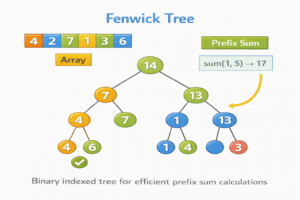
Unlike a standard array where index i holds value i, in a Fenwick Tree, index i holds the sum of a specific range determined by the Least Significant Bit (LSB) of i. It allows you to jump through the array in powers of 2 to calculate sums.
Real-World Analogy:
Imagine a Bucket System for collecting coins.
- Bucket 1 holds coins from day 1.
- Bucket 2 holds coins from day 1-2.
- Bucket 4 holds coins from day 1-4.
To find the total for 13 days, you don’t add 13 buckets. You grab the “Day 1-8” bucket, the “Day 9-12” bucket, and the “Day 13” bucket. Just 3 steps!
Code Example
PythonJavaCC++
# Update BIT (Fenwick Tree)
def update(BIT, n, i, val):

    i += 1   # convert to 1-based index

    while i  0:

        s += BIT[i]
        i -= i & (-i)   # move to parent

    return s


arr = [1, 2, 3, 4, 5]

n = len(arr)

BIT = [0] * (n + 1)

# Build Fenwick Tree
for i in range(n):
    update(BIT, n, i, arr[i])

print("Sum of first 3 elements:", query(BIT, 2))  # 6
class FenwickTree {

    int[] BIT;
    int n;

    FenwickTree(int n) {

        this.n = n;
        BIT = new int[n + 1];
    }

    // Update BIT
    void update(int i, int val) {

        i = i + 1;

        while (i  0) {

            sum += BIT[i];
            i -= i & (-i);
        }

        return sum;
    }

    public static void main(String[] args) {

        int arr[] = {1,2,3,4,5};
        int n = arr.length;

        FenwickTree ft = new FenwickTree(n);

        for (int i = 0; i < n; i++)
            ft.update(i, arr[i]);

        System.out.println("Sum of first 3 elements: " + ft.query(2));
    }
}
#include <stdio.h>

void update(int BIT[], int n, int i, int val) {

    i = i + 1;

    while (i  0) {

        sum += BIT[i];
        i -= i & (-i);
    }

    return sum;
}

int main() {

    int arr[] = {1,2,3,4,5};
    int n = 5;

    int BIT[6] = {0};

    for (int i = 0; i < n; i++)
        update(BIT, n, i, arr[i]);

    printf("Sum of first 3 elements: %d\n", query(BIT, 2));

    return 0;
}
#include <iostream>
#include <vector>
using namespace std;

class FenwickTree {

public:

    vector<int> BIT;
    int n;

    FenwickTree(int n) {

        this->n = n;
        BIT.resize(n + 1, 0);
    }

    // Update BIT
    void update(int i, int val) {

        i = i + 1;

        while (i  0) {

            sum += BIT[i];
            i -= i & (-i);
        }

        return sum;
    }
};

int main() {

    int arr[] = {1,2,3,4,5};
    int n = 5;

    FenwickTree ft(n);

    for (int i = 0; i < n; i++)
        ft.update(i, arr[i]);

    cout << "Sum of first 3 elements: "
         << ft.query(2) << endl;

    return 0;
}
Complexity Analysis
- Time Complexity:
- Update: O(log n)
- Query: O(log n)
- Space Complexity: O(n) (Uses same space as the input array, unlike Segment Tree).
Use Cases
- Cumulative Frequencies: Often used in data compression algorithms.
- Counting Inversions: Used to measure how “unsorted” an array is.
- Gaming Leaderboards: Calculating ranks dynamically.