
Dynamic Programming on Trees
Definition
DP on Trees involves solving a problem for a root node by combining results from its children sub-trees. It’s essentially “Post-Order Traversal” (Left, Right, Root) combined with DP logic.
How it Works
- Leaf Nodes: These are the base cases (e.g., diameter is 0).
- Recursive Step: For a node u, calculate the answer based on answers from children v1, v2….
- Example Problem (Diameter of Tree): The longest path between any two nodes. The path either passes through the root or is entirely inside one of the sub-trees.
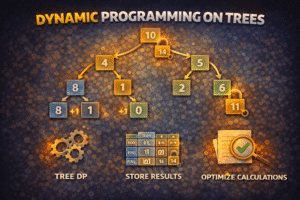
Example Logic (Tree Diameter)
For every node, calculate:
- Height of left subtree (L).
- Height of right subtree (R).
- Diameter passing through this node = L + R + 1.
- Update global maximum diameter.
- Return max(L, R) + 1 to the parent.
Code Example
PythonJavaCC++
# Node class
class Node:

    def __init__(self, data):
        self.data = data
        self.left = None
        self.right = None


# Diameter of Binary Tree
def diameter(root, res):

    if root is None:
        return 0

    # Heights of left and right subtree
    l = diameter(root.left, res)
    r = diameter(root.right, res)

    # Update maximum diameter
    res[0] = max(res[0], l + r + 1)

    # Return height
    return max(l, r) + 1


# Build tree
root = Node(1)
root.left = Node(2)
root.right = Node(3)

res = [-1]

diameter(root, res)

print("Diameter is", res[0])
class Node {

    int data;
    Node left, right;

    Node(int data) {

        this.data = data;
        left = right = null;
    }
}

public class DiameterOfTree {

    public static int diameter(Node root, int[] res) {

        if (root == null)
            return 0;

        int l = diameter(root.left, res);
        int r = diameter(root.right, res);

        res[0] = Math.max(res[0], l + r + 1);

        return Math.max(l, r) + 1;
    }

    public static void main(String[] args) {

        Node root = new Node(1);
        root.left = new Node(2);
        root.right = new Node(3);

        int[] res = new int[]{-1};

        diameter(root, res);

        System.out.println("Diameter is " + res[0]);
    }
}
#include <stdio.h>
#include <stdlib.h>

struct Node {

    int data;
    struct Node* left;
    struct Node* right;
};

struct Node* newNode(int data) {

    struct Node* node =
        (struct Node*)malloc(sizeof(struct Node));

    node->data = data;
    node->left = NULL;
    node->right = NULL;

    return node;
}

int diameter(struct Node* root, int* res) {

    if (root == NULL)
        return 0;

    int l = diameter(root->left, res);
    int r = diameter(root->right, res);

    if (l + r + 1 > *res)
        *res = l + r + 1;

    return (l > r ? l : r) + 1;
}

int main() {

    struct Node* root = newNode(1);
    root->left = newNode(2);
    root->right = newNode(3);

    int res = -1;

    diameter(root, &res);

    printf("Diameter is %d\n", res);

    return 0;
}
#include <iostream>
using namespace std;

class Node {

public:
    int data;
    Node* left;
    Node* right;

    Node(int data) {

        this->data = data;
        left = right = NULL;
    }
};

int diameter(Node* root, int &res) {

    if (root == NULL)
        return 0;

    int l = diameter(root->left, res);
    int r = diameter(root->right, res);

    res = max(res, l + r + 1);

    return max(l, r) + 1;
}

int main() {

    Node* root = new Node(1);
    root->left = new Node(2);
    root->right = new Node(3);

    int res = -1;

    diameter(root, res);

    cout << "Diameter is " << res;

    return 0;
}
Complexity Analysis
- Time Complexity: O(N. We visit every node once.
- Space Complexity: O(H) where H is the height of the tree (recursion stack).
Use Cases
- Network Routing: Finding optimal paths in hierarchical networks.
- Company Hierarchy: Calculating total salary of a department (subtree sum).