
Depth First Search (DFS)
Definition
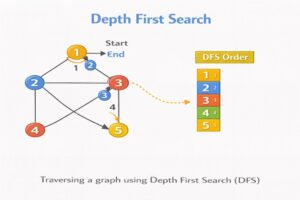
DFS is a traversal algorithm that explores a path as deep as possible before backtracking. It dives into a “branch” of the graph all the way to the end, then steps back to try other paths.
How it Works
- Start at a node.
- Mark it as visited.
- Pick an adjacent unvisited neighbor and move to it.
- Repeat step 3 until you hit a dead end.
- Backtrack (return to the previous node) and check for other unvisited neighbors.
Real-World Analogy
Solving a Maze: You pick a path and keep walking until you hit a wall. Once you hit a wall, you retrace your steps back to the last intersection and try a different path.
Code Example
PythonJavaCC++
# Depth First Search (DFS)

def dfs(graph, node, visited):

    if node not in visited:

        print(node, end=" ")
        visited.add(node)

        # Visit neighbors
        for neighbor in graph[node]:
            dfs(graph, neighbor, visited)


# Graph using adjacency list
graph = {
    'A': ['B', 'C'],
    'B': ['D', 'E'],
    'C': ['F'],
    'D': [],
    'E': [],
    'F': []
}

print("DFS Traversal:")
dfs(graph, 'A', set())
import java.util.*;

public class DFSExample {

    static void dfs(Map<String, List<String>> graph,
                    String node,
                    Set<String> visited) {

        if (!visited.contains(node)) {

            System.out.print(node + " ");
            visited.add(node);

            for (String neighbor : graph.get(node))
                dfs(graph, neighbor, visited);
        }
    }

    public static void main(String[] args) {

        Map<String, List<String>> graph = new HashMap<>();

        graph.put("A", Arrays.asList("B","C"));
        graph.put("B", Arrays.asList("D","E"));
        graph.put("C", Arrays.asList("F"));
        graph.put("D", new ArrayList<>());
        graph.put("E", new ArrayList<>());
        graph.put("F", new ArrayList<>());

        System.out.println("DFS Traversal:");

        dfs(graph, "A", new HashSet<>());
    }
}
#include <stdio.h>

#define N 6

void dfs(int graph[N][N], int node, int visited[]) {

    printf("%d ", node);
    visited[node] = 1;

    for (int i = 0; i < N; i++) {

        if (graph[node][i] && !visited[i])
            dfs(graph, i, visited);
    }
}

int main() {

    int graph[N][N] = {
        {0,1,1,0,0,0},
        {0,0,0,1,1,0},
        {0,0,0,0,0,1},
        {0,0,0,0,0,0},
        {0,0,0,0,0,0},
        {0,0,0,0,0,0}
    };

    int visited[N] = {0};

    printf("DFS Traversal:\n");

    dfs(graph, 0, visited);

    return 0;
}
#include <iostream>
#include <map>
#include <vector>
#include <set>
using namespace std;

void dfs(map<char, vector<char>>& graph,
         char node,
         set<char>& visited) {

    if (visited.count(node) == 0) {

        cout << node << " ";
        visited.insert(node);

        for (char neighbor : graph[node])
            dfs(graph, neighbor, visited);
    }
}

int main() {

    map<char, vector<char>> graph;

    graph['A'] = {'B','C'};
    graph['B'] = {'D','E'};
    graph['C'] = {'F'};
    graph['D'] = {};
    graph['E'] = {};
    graph['F'] = {};

    set<char> visited;

    cout << "DFS Traversal:" << endl;

    dfs(graph, 'A', visited);

    return 0;
}
Complexity & Use Cases
- Time: O(V + E) – You visit every node and edge once.
- Space: O(V) – Stack space for recursion.
- Use Cases: Solving puzzles (mazes, Sudoku), detecting cycles in a graph, finding connected components.