
What is Machine Learning
The Simple Definition
At its core, Machine Learning (ML) is a branch of artificial intelligence that focuses on building systems that learn or improve performance based on the data they consume.
Instead of writing a rigid set of instructions (code) to tell a computer exactly how to solve a problem, you give the computer a lot of examples and let it figure out the patterns on its own.
Think of it like teaching a child to recognize an apple. You don’t hand them a list of rules (e.g., “It must be red or green, round, with a stem, and weigh between 100-200 grams”). Instead, you just show them a bunch of apples and say, “This is an apple.” Eventually, their brain connects the dots. Machine Learning does exactly this, but with algorithms instead of a human brain.
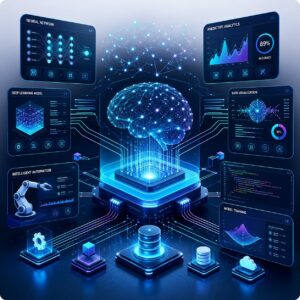
Connecting the Dots: Traditional Programming vs. Machine Learning
To truly grasp ML, it helps to compare it to what you likely already know: traditional computer programming.
- Traditional Programming: You input Data and Rules (your code) into a computer, and the computer outputs the Answers.
- Example: You write a program that says, “If an email contains the word ‘Viagra’, send it to the spam folder.”
- Machine Learning: You input Data and the Answers into the computer, and the computer outputs the Rules (we call this rulebook a “Model”).
- Example: You feed the computer 10,000 regular emails and 10,000 spam emails. The computer analyzes them and figures out its own complex set of rules for what makes an email spam.
How It Works: A Step-by-Step Flow
So, how does a machine actually “learn”? It generally follows a logical four-step cycle:
- Gathering Data: This is the most crucial step. A machine can only learn if it has a textbook to study from. This data could be text, images, numbers, or audio.
- Training the Algorithm: You feed this data into a mathematical algorithm. The algorithm’s job is to sift through the data and hunt for hidden patterns, correlations, and features.
- Building the Model: Once the algorithm has found the patterns, it saves what it learned into a “Model.” You can think of the model as the final, trained brain that now understands the topic.
- Making Predictions (Inference): Now for the test! You give your trained model brand new data it has never seen before, and it uses its learned patterns to make a prediction or decision.

Real-Life Examples & Practical Use Cases
Machine learning isn’t just a futuristic concept; it is powering the technology you use every single day. Here are a few practical use cases:
- Streaming Recommendations: When Netflix or Spotify says, “Because you liked X, you might like Y,” that is a machine learning model. It has studied the viewing habits of millions of users to find patterns in what people enjoy watching together.
- Self-Driving Cars: Autonomous vehicles use ML to process millions of images from their cameras in real-time, learning the difference between a stop sign, a pedestrian, and a plastic bag blowing across the road.
- Fraud Detection: Your bank uses ML to monitor your credit card. If you usually buy coffee in Mumbai and suddenly there is a $5,000 electronics purchase in Paris, the model flags it as an anomaly and blocks the transaction.
- Medical Diagnosis: Doctors use ML models trained on thousands of X-rays to help spot early signs of diseases, like pneumonia or tumors, sometimes with higher accuracy than the human eye.
Summary
To wrap it up: Machine Learning is the science of getting computers to act without being explicitly programmed. By swapping out rigid, hand-written rules for data-driven pattern recognition, we allow computers to solve incredibly complex problems that would be impossible for a human to code from scratch.