
What is Customer Segmentation?
Customer Segmentation is the process of dividing a large group of customers into smaller subgroups based on shared characteristics.
Imagine you own a massive clothing store. If you treat a 16-year-old student looking for sneakers the exact same way you treat a 50-year-old professional looking for a suit, you’ll probably lose both of them. Segmentation allows you to treat different people differently, but in a way that makes sense for each group.
Project 3: Customer Segmentation
In this project, you will build a model that looks at a database of thousands of customers and automatically organizes them into “tribes” or “segments.”
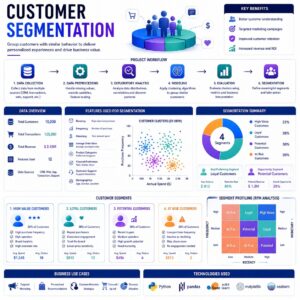
Step 1: Finding Patterns (Clustering)
In our previous projects, we used Supervised Learning (where we told the computer the “answer,” like the price of a house). This project uses Unsupervised Learning, specifically a technique called Clustering.
- The Concept: Clustering is when you give a computer data without any labels and ask it to find similarities on its own.
- The Connection: Think of it like a giant pile of mixed Lego bricks. You don’t tell the computer what a “red brick” is; you just say, “Put things that look alike into five different piles.” The computer might group them by color, size, or shape.
Step 2: Interpreting the “Piles” (Business Insights)
The computer will give you the clusters, but it won’t tell you what they mean. This is where the human element comes in to turn math into Business Insights.
- Example: You run your model on a grocery store’s data.
- Cluster A: People who buy organic kale and expensive olive oil. (Insight: The “Health-Conscious Big Spender” group).
- Cluster B: People who buy diapers and baby formula at 10 PM. (Insight: The “New Parents” group).
- Cluster C: People who only visit when there’s a 50% off sale. (Insight: The “Deal Hunters”).
- Why it matters: Once you know who is in which group, you can send a “Buy one, get one free” coupon for diapers only to Cluster B.
Step 3: Actionable Strategy
The final step isn’t just about the code; it’s about what the business does next. Using these insights, a company can decide which products to stock, how to design their website, or even where to open their next physical store.
Practical Use Cases
- Streaming Services: Netflix clusters users into “Taste Communities.” If you and 1,000 other people all like Sci-Fi and Cooking shows, you’ll all see the same “Top Picks” because you belong to the same cluster.
- E-commerce: Amazon uses segmentation to show you “Recommended for You” items based on what people “like you” have purchased.
- Credit Card Companies: They segment users based on spending habits to detect fraud. If you belong to a cluster of “Homebodies” and suddenly there is a charge for a luxury hotel in Paris, the system flags it.
Why This Connects to Your Learning
You have now seen the full spectrum of Machine Learning:
- Regression (Project 1): Predicting a number.
- Classification (Project 2): Predicting a label.
- Clustering (Project 3): Finding hidden structures.
By mastering Clustering, you’ve moved from just “answering questions” to “asking the right questions” about your data.
Projects & GitHub
Machine Learning Projects : Customer Segmentation
Group customers using clustering algorithms like K-Means.
GitHub: https://github.com/topics/customer-segmentation-analysis
Summary
Customer Segmentation is the art of using Clustering to find order in chaos. It takes raw, unlabeled data and transforms it into valuable Business Insights. Instead of guessing what your customers want, you let the data tell you who they are.