
Grid Search
The Simple Definition
Grid Search is a model improvement algorithm that exhaustively tests every possible combination of settings (hyperparameters) to find the absolute best version of your machine learning model.
Imagine you forgot the 3-digit code to a combination lock. How do you open it? You start at 0-0-0, then try 0-0-1, then 0-0-2, all the way to 9-9-9. You systematically test every single possible combination until it clicks open. Grid Search does the exact same thing to find the perfect settings for your algorithm.
Connecting to What We’ve Built So Far
Let’s look at the toolkit you have built in this course:
- You learned that models can suffer from Overfitting or Underfitting.
- You learned that you can fix this by adjusting the model’s dials, a process called Hyperparameter Tuning.
- You learned how to fairly score a model using Cross-Validation.
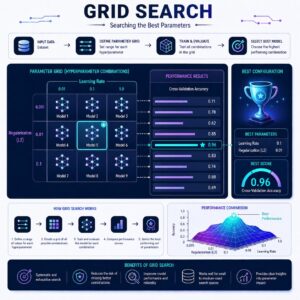
But how do you actually decide which combinations of dials to test? Do you just guess randomly? No! This is where Grid Search comes in. It is the organized, brute-force method that automatically twists the dials for you, scores each combination using Cross-Validation, and hands you the winning settings.
Step-by-Step: How Grid Search Works
Let’s say we are training a Decision Tree algorithm to predict if a student will pass a technical interview. We want to tune two specific dials (hyperparameters):
- Max Depth: How many questions the tree is allowed to ask (Let’s test: 3, 5, and 10).
- Minimum Samples: The minimum number of students required to make a decision (Let’s test: 2, 4, and 6).
Here is the logical flow of Grid Search:
Step 1: Create the “Grid”
The algorithm creates a literal grid (or table) mapping out every possible combination of the options you provided. Since we gave it 3 options for Depth and 3 options for Samples, our grid has 9 unique combinations ($3 \times 3 = 9$).
Step 2: Test Combination #1
The computer sets the algorithm to Max Depth 3 and Minimum Samples 2. It trains the model and evaluates it using Cross-Validation. Let’s say it scores 72% accuracy.
Step 3: Exhaustive Iteration
The computer moves to the next square on the grid: Max Depth 3 and Minimum Samples 4. It tests it and gets 75% accuracy. It repeats this tedious process for every single one of the 9 squares.
Step 4: Crown the Winner
Once the entire grid is complete, the algorithm reviews all the scores. It finds that Max Depth 5 and Minimum Samples 4 yielded the highest score of 88% accuracy. It automatically configures your model to these winning settings, and your optimized model is ready to go!
Practical Use Cases
Because Grid Search tests everything, it is incredibly thorough but can take a lot of computing power. Where is it used?
- Medical Imaging: When building a model to detect tumors in MRI scans, engineers cannot afford to “guess” the best settings. They will use Grid Search and let supercomputers run for days to test millions of combinations, ensuring the model is as accurate as biologically possible.
- Algorithmic Trading: Financial models that buy and sell stocks in milliseconds rely on highly tuned algorithms. Engineers use Grid Search to find the exact historical window (e.g., looking at the past 14 vs. 15 days) and learning rate that maximizes profit while minimizing risk.
- Customer Churn Prediction: Telecommunication companies use Grid Search to fine-tune the models that predict if a customer is about to cancel their subscription, allowing them to offer a discount at the exact right moment.
Summary
While you could manually guess which settings make your algorithm run best, Grid Search automates the process with mathematical certainty. By defining a list of options for your hyperparameters, Grid Search creates a matrix of every possible combination. It systematically trains and tests a model for every single cell in that grid, ensuring you walk away with the absolute most accurate version of your machine learning model.