
Supervised Machine Learning
Welcome back to our Machine Learning journey! In our previous lessons, we established that Machine Learning (ML) is all about teaching computers to recognize patterns in data rather than giving them strict, line-by-line programming instructions.
Today, we are diving into the most common and widely used branch of this field: Supervised Machine Learning.
What is Supervised Machine Learning? (A Simple Definition)
Imagine you are teaching a child to identify different types of fruit. You hold up an apple and say, “This is an apple.” You hold up a banana and say, “This is a banana.” You do this dozens of times. Eventually, when you hold up a new apple, the child recognizes its shape and color and correctly guesses, “Apple!”
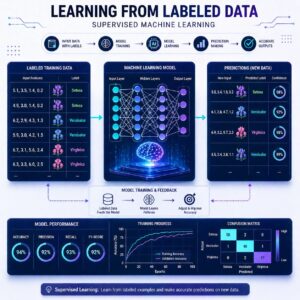
Supervised Machine Learning works exactly the same way. It is a type of machine learning where we train the computer using data that already has the “answers” attached to it. We act as the supervisor or teacher, showing the algorithm examples until it learns the underlying patterns well enough to make guesses on its own.
The Two Words You Need to Know
Before we look at the steps, let’s learn two simple terms used in every supervised learning project:
- Features (The Clues): These are the inputs or characteristics the computer looks at (e.g., the red color and round shape of an apple).
- Labels (The Answers): This is the final output or category we want the computer to predict (e.g., the word “Apple”).
How It Works: A Step-by-Step Flow
Supervised learning generally follows a four-step cycle:
- Collect the Labeled Data
First, you gather a dataset full of examples. Importantly, every single example must have both the features and the label.
- Train the Model
You feed this labeled data into a mathematical algorithm. During this phase, the algorithm looks at the features and the labels and tries to figure out the relationship between them. It asks itself, “What makes an apple an apple?”
- Test the Model
Just like giving a student an exam, we need to make sure the computer actually learned the concepts and didn’t just memorize the flashcards. We give the model a new set of data it hasn’t seen before, hide the labels, and see how many it guesses correctly.
- Make Real-World Predictions
Once the model passes the test with a high accuracy score, it is ready for the real world! You can now give it brand-new, unlabeled data, and it will use what it learned to predict the answers.
Real-Life Examples to Make It Click
To see how broad this is, let’s look at two classic examples:
Example 1: The Email Spam Filter
- The Features: The words used in the email, the sender’s address, the number of exclamation marks, and suspicious links.
- The Label: “Spam” or “Not Spam”.
- How it works: You train the algorithm with thousands of emails that humans have already marked as spam or safe. It learns that emails containing “CONGRATULATIONS YOU WON” are usually spam. When a new email arrives tomorrow, the model filters it automatically.
Example 2: House Price Estimator
- The Features: Square footage, number of bedrooms, neighborhood, and age of the house.
- The Label: The price of the house in dollars.
- How it works: By studying historical sales data, the algorithm learns how much a bedroom is worth or how much value a certain neighborhood adds. You can then input the features of a newly built house, and the algorithm will estimate a fair selling price.
Practical Use Cases in the Wild
Supervised learning powers many of the technologies you use every day:
- Healthcare: Analyzing patient X-rays to detect if a tumor is present or absent.
- Finance: Monitoring credit card transactions in real-time to flag them as “Legitimate” or “Fraudulent”.
- Entertainment: Streaming services categorizing a movie’s genre based on its plot description and cast.
- Autonomous Vehicles: Helping self-driving cars recognize whether an object in the road is a “Pedestrian,” “Stop Sign,” or “Another Car.”
Summary
If you have a dataset where every row has a clear “answer” (a label), and you want a computer to predict that answer for future data, you need Supervised Machine Learning. You provide the examples, the computer learns the patterns, and eventually, it can do the job on its own.