
What is Customer Churn?
Customer Churn is a simple term for when a customer stops doing business with a company. Think about a person canceling their Netflix subscription or switching from one cell phone provider to another.
For a company, it’s much cheaper to keep an old customer than to find a new one. That’s why we build ML models to predict who is about to leave, so the company can offer them a discount or a reason to stay before they hit “cancel.”
Project 2: Customer Churn Prediction
In this project, you will build a system that looks at a customer’s usage habits and flags them as either “Loyal” or “At Risk.”
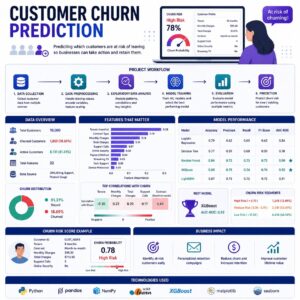
Step 1: The Goal (Classification)
In Project 1, we used Regression to predict a number. Here, we use Classification.
- The Concept: Classification is used when the output is a category or a label.
- The Connection: Instead of asking “How much?”, we are asking “Which one?” In this case, it’s a Binary Classification because there are only two choices: Churn (Yes) or No Churn (No).
Step 2: The Cleanup (Data Preprocessing)
Real-world customer data is often “dirty.” You might have missing phone numbers, or dates formatted in three different ways.
- Handling Categorical Data: Computers don’t understand words like “Basic Plan” or “Premium Plan.” In this step, you convert those words into numbers (like 0 and 1) so the math can work.
- Scaling: If one feature is “Monthly Spend” ($10 to $500) and another is “Years as Customer” (1 to 5), the computer might think the dollar amount is 100 times more important just because the number is bigger. Preprocessing balances these so the model treats them fairly.
Step 3: Turning the Knobs (Model Tuning)
Once you have a basic model, you want to make it better. This is called Model Tuning (or Hyperparameter Tuning).
- The Real-Life Analogy: Imagine you’re baking a cake. You have the ingredients (the data) and the oven (the model). Tuning is like adjusting the temperature and the baking time to get the perfect rise.
- The Goal: You are looking for the “sweet spot” where the model is smart enough to recognize patterns but not so specific that it only works on the training data.
Practical Use Cases
- Subscription Services: Spotify uses churn models to see if you’ve stopped listening to music as much as usual—if you have, they might send you a “We miss you” email with a curated playlist.
- Banking: Banks look for “churn signals,” like a customer withdrawing all their money, to trigger a call from a customer service representative.
- SaaS (Software as a Service): Companies that sell software to other businesses use these models to protect their most valuable contracts.
Why This Connects to Your Learning
You’ve already mastered Regression (predicting amounts). Now, you are learning Classification (predicting groups). This expands your ML toolkit to solve problems involving logic and probability rather than just trends. You are also learning that the quality of your data (Preprocessing) is often more important than the algorithm itself.
GitHub Code Repository
Machine Learning Projects: Customer Churn Prediction
Identify customers likely to leave using classification models.
GitHub: https://github.com/topics/customer-churn-prediction
Summary
Customer Churn Prediction is the bridge between pure math and business strategy. By using Classification, cleaning your data through Preprocessing, and optimizing your results with Model Tuning, you create a tool that can save a company millions of dollars by simply knowing when to say “Wait, don’t go!”