
What is a “Real-World” ML Project?
In simple terms, a Real-World ML Project is the process of taking raw, messy data from the everyday world and using a computer algorithm to find patterns that help us make predictions or decisions.
Instead of just solving a math equation on paper, you are building a tool that could actually help a business or an individual solve a problem.
Project 1: House Price Prediction
This is the classic “Hello World” of Machine Learning. Your goal is to build a model that can look at the characteristics of a house and predict its market value.
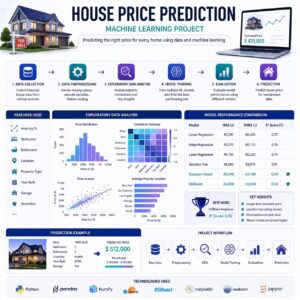
Step 1: The Foundation (Regression)
In our previous lessons, we talked about Supervised Learning. House price prediction falls under a sub-category called Regression.
- The Concept: Regression is used when we want to predict a specific numerical value (like $450,000) rather than a category (like “True” or “False”).
- The Connection: If you remember “Line of Best Fit” from math class, that’s exactly what we’re doing here—finding the line that best represents the relationship between house size and price.
Step 2: The Ingredients (Feature Engineering)
Raw data is rarely ready for a model. You have to “clean” and “prepare” it. This is called Feature Engineering.
- What are Features? These are the variables that influence the price.
- Examples: Square footage, number of bedrooms, age of the house, and proximity to schools.
- The Real-Life Twist: Imagine you have a column for “Renovated Year.” A computer might not understand that. You might transform that into a “Yes/No” feature or calculate “Years since last renovation” to make it more useful for the model.
Step 3: The Trial Run (Model Evaluation)
Once your model makes a prediction, how do you know if it’s any good? You can’t just guess; you need metrics.
- Mean Absolute Error (MAE): This tells you, on average, how many dollars your prediction was off by. If your MAE is $5,000, your model is very accurate! If it’s $100,000, you might need to go back to Step 2.
Practical Use Cases
Why does this project matter beyond the classroom? Here is how this logic is used today:
- Real Estate Apps: Platforms like Zillow or Redfin use these exact regression models to give you an “estimated value” for your home instantly.
- Insurance: Companies use similar models to predict the cost of repairs after a car accident or a natural disaster.
- Dynamic Pricing: Ever notice how Uber prices change based on traffic or weather? That’s a regression model predicting the “fair price” for that specific moment.
Why This Connects to Your Learning
You’ve already learned about Data Types and Basic Algorithms. This project bridges that gap by showing you that:
- Data is messy: You’ll spend more time cleaning data than actually “coding” the AI.
- Context matters: A house near a beach is worth more than the same house in a desert. Learning to pick the right “features” is the secret sauce of a great ML Engineer.
GitHub Code Repository
Machine Learning Projects: House Price Prediction
Predict house prices using regression techniques.
GitHub:https://github.com/topics/housing-price-prediction
Summary
Building a House Price Prediction model teaches you the end-to-end workflow of a data scientist. You start with a Regression goal, refine your data through Feature Engineering, and prove your success through Model Evaluation. It’s the perfect first step b