
Machine Learning applications
Welcome back! In our previous lessons, we covered the “how” of Machine Learning: how we feed data into algorithms so they can figure out the rules, and the two main ways they learn (Supervised and Unsupervised Learning).
But what happens after the machine has learned? How does a trained model actually help us? That brings us to today’s topic: Machine Learning Applications in Real Life.
The Simple Definition
An ML Application is simply a trained Machine Learning model wrapped inside a piece of software or hardware that people use to solve a specific problem.
If building an ML model is like sending a chef to culinary school to learn how to cook, the ML application is the restaurant where they finally serve meals to real customers.
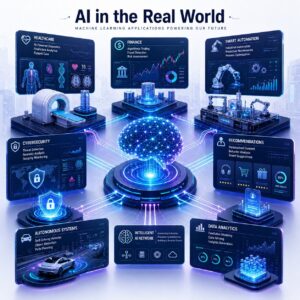
How a Model Becomes an Application (Step-by-Step)
To understand how this works in the real world, let’s look at the flow of bringing an ML idea to life:
- The Problem: A company decides they want to solve a problem (e.g., “Too many customers are getting their credit cards stolen”).
- The Training (The Lab): Data scientists use historical data (millions of normal and stolen transactions) to train a model. They might use Supervised Learning here, showing the model examples labeled “Fraud” and “Not Fraud.”
- The Integration (The Bridge): Once the model is smart enough, engineers plug it into the bank’s live computer systems.
- The Application (Real Life): You swipe your card to buy a coffee. In milliseconds, the ML application analyzes the swipe, predicts it is safe, and approves the transaction.
Connecting the Concepts: Real-Life Examples
You interact with dozens of ML applications every single day, often without even realizing it. Let’s look at a few major areas and connect them to what we’ve already learned.
1. Your Smartphone & Daily Tech
- Face ID/Facial Recognition: When you look at your phone to unlock it, an ML model is running. It was trained using Supervised Learning on thousands of angles of your face (labeled “You”) so it can instantly recognize you and ignore everyone else.
- Virtual Assistants (Siri, Alexa, Google Assistant): These tools use Natural Language Processing (a type of ML) to understand your messy, human speech, translate it into computer commands, and speak back to you.
2. Entertainment & E-Commerce
- Recommendation Engines: Ever wonder how Netflix knows exactly what thriller you want to watch next, or how Amazon suggests the perfect pair of shoes? They use Unsupervised Learning. The model looks at millions of users, clusters people with similar viewing or buying habits together, and recommends things your “cluster” likes.
3. Healthcare & Medicine
- Medical Imaging: Doctors are using ML applications to look at X-rays and MRI scans. By using Supervised models trained on millions of historical scans, the application can highlight tiny anomalies—like a hairline fracture or an early-stage tumor—that a tired human eye might miss.
- Drug Discovery: Finding new medicines used to take decades of trial and error. Now, ML models can predict how different chemical compounds will react together, speeding up the creation of life-saving drugs.
4. Transportation
- Navigation Apps (Google Maps): When your map app routes you around a traffic jam, it is using ML. It analyzes historical traffic patterns and combines them with real-time speed data from other phones on the road to predict the fastest route.
- Self-Driving Cars: This is one of the most complex ML applications! Cars use cameras and sensors to constantly feed data into models that classify objects (Supervised Learning: “That is a stop sign”) and make split-second driving decisions.
Summary
Machine Learning applications are the final, usable products of all that complex data science. By using the concepts of Supervised and Unsupervised learning, developers can build tools that act as our personal assistants, protect our money, keep us entertained, and even save our lives. The “magic” of AI is really just math and data quietly working behind the scenes of the apps you use every day.