
Types of Machine Learning
Welcome back! In our previous lesson, we learned that Machine Learning (ML) is all about swapping out rigid, hand-written code for data. Instead of giving the computer the rules, we give it the data and the answers, and it figures out the rules (the model).
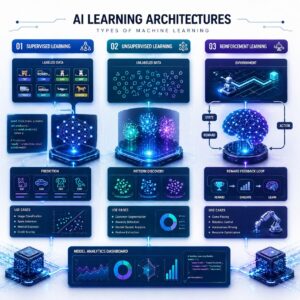
But how exactly do we feed this data to the computer? Does it always have the answers beforehand? That brings us to the two most common ways machines learn: Supervised Learning and Unsupervised Learning.
Let’s break them down simply.
1. Supervised Learning: The “Show and Tell” Method
The Simple Definition: Supervised learning is when you train an ML model using labeled data. This means you act as a “teacher” and give the computer both the data and the correct answers upfront so it can learn by example.
How it Works (Step-by-Step):
- Provide Labeled Data: You give the computer thousands of pictures of cats and dogs. Crucially, each picture has a tag (a “label”) saying either “This is a cat” or “This is a dog.”
- The Model Learns: The algorithm studies the images and connects the dots. It realizes, “Ah, pointy ears and whiskers usually mean ‘cat’, while floppy ears often mean ‘dog’.”
- The Test: You show the model a brand new, unlabeled picture of a dog.
- The Prediction: Because it learned from your examples, it confidently predicts: “That is a dog!”
Real-Life Example:
Think of supervised learning like studying with flashcards. You look at the front (the data, e.g., “5 x 5”) and then check the back for the answer (the label, e.g., “25”). Once you’ve studied enough flashcards, you can take a test on new math problems you haven’t memorized yet.
Practical Use Cases:
- Spam Filters: Your email provider is trained on thousands of emails labeled as “Spam” or “Not Spam.”
- Price Predictions: Predicting the price of a house based on historical data where the final sale price (the label) is known.
2. Unsupervised Learning: The “Figure It Out” Method
The Simple Definition: Unsupervised learning is when you give the computer data with no labels and no instructions. There is no teacher. The machine’s job is to explore the data and find hidden structures, patterns, or groupings entirely on its own.
How it Works (Step-by-Step):
- Provide Unlabeled Data: You hand the computer a giant folder containing millions of customer receipts. You don’t label anything; you just say, “Here is a bunch of data.”
- The Model Explores: The algorithm analyzes the receipts, looking for similarities.
- Finding Patterns (Clustering): The model groups the data based on shared traits. It might notice, “People who buy diapers often buy baby wipes and coffee.”
- The Output: It hands you back neatly organized clusters of data that you didn’t even know existed.
Real-Life Example:
Imagine someone hands you a massive jar of foreign coins you have never seen before. You don’t know what country they are from or how much they are worth (no labels!). But without anyone teaching you, you can still sort them into piles based on their size, color, or the shape of the hole in the middle. That is unsupervised learning!
Practical Use Cases:
- Customer Segmentation: Marketing teams use this to group customers with similar buying habits so they can run targeted ad campaigns.
- Genetics: Biologists use it to group similar DNA sequences together to discover new traits or evolutionary links.
Summary: A Quick Comparison
To tie it all together, here is a quick way to remember the difference:
|
Feature |
Supervised Learning |
Unsupervised Learning |
|
The Data |
Labeled (Has the answers) |
Unlabeled (No answers) |
|
The Goal |
Predict an outcome for new data. |
Discover hidden patterns or groups. |
|
The Analogy |
Studying with a teacher and an answer key. |
Exploring a new city without a map. |