
🧑💻OOPS in Java – The Heart of Modern Programming
Java is one of the most popular programming languages in the world 🌍 — and the secret behind its power is OOPS (Object-Oriented Programming System).
Instead of treating programs as a list of instructions, OOPS allows us to think in terms of real-world objects — like a Car, Student, or Bank Account.
👉 This makes programs easier to understand, reuse, and maintain.
🎯 What is OOPS?
OOPS (Object-Oriented Programming System) is a programming paradigm based on the concept of objects. OOPS is a programming paradigm that organizes code around objects instead of just functions and logic.
-
👉 An object represents a real-world entity. It has:
-
State (data/variables) → What it has
-
Behavior (methods/functions) → What it does
And a class is like a blueprint for creating such objects.
-
🌍 Real-World Example: Car Showroom
Let’s imagine you walk into a Car Showroom.
-
Class (Blueprint):
The company has a design (class) for a Car. It defines:-
Brand
-
Color
-
Engine Capacity
-
Drive() method
-
-
Object (Real Cars):
Using that blueprint, many cars can be created:-
Car 1 → Tesla, Red, 2000cc
-
Car 2 → BMW, Black, 2500cc
-
🚀 Why Learn OOPS in Java?
✔️ Real-world problem-solving
✔️ Cleaner, modular, and maintainable code
✔️ Code reusability (less repetition)
✔️ Foundation for frameworks like Spring, Hibernate
✔️ Industry standard in enterprise applications
💡 Example:
class Car {
    String brand;
    int speed;

    void drive() {
        System.out.println(brand + " is driving at " + speed + " km/h");
    }
}

public class Main {
    public static void main(String[] args) {
        Car car1 = new Car();
        car1.brand = "Tesla";
        car1.speed = 120;
        car1.drive();
    }
}
Output:
Tesla is driving at 120 km/h
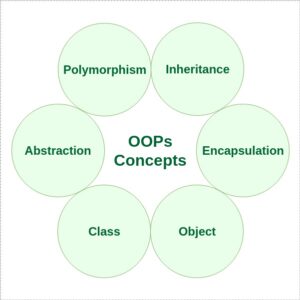
🏗️ The 4 Pillars of OOPS in Java
| Pillar | What it means | Real-life Example |
|---|---|---|
| Encapsulation | Data hiding & protection | Medicine capsule with hidden content |
| Inheritance | Reusing existing code | Son inherits traits from father |
| Polymorphism | Many forms of same action | Man as father, employee, customer |
| Abstraction | Hiding details, showing essentials | Driving a car without knowing engine internals |
1️⃣ Encapsulation – The Capsule of Data 💊
-
Wrapping variables and methods into a single unit (class).
-
Protects data using getters & setters.
- For Car example
-
Each car hides its engine details; you just use the accelerator.
-
class Student {
    private String name;  // private data

    public void setName(String name) { this.name = name; }
    public String getName() { return name; }
}
2️⃣ Inheritance – Reusing the Family Traits 👨👩👦
-
Allows a class to inherit properties and methods from another class.
-
Promotes code reusability.
- For Car example
- An ElectricCar can inherit from Car but add battery features.
class Animal {
    void sound() { System.out.println("Animal makes a sound"); }
}
class Dog extends Animal {
    void sound() { System.out.println("Dog barks"); }
}
3️⃣ Polymorphism – One Word, Many Forms 🎭
-
Compile-time (Method Overloading) → Same method name, different parameters.
-
Runtime (Method Overriding) → Child class redefines parent method.
- For Car example
- The
drive()method might work differently for a SportsCar vs. a Truck.
- The
class Calculator {
    int add(int a, int b) { return a+b; }            // Overloading
    double add(double a, double b) { return a+b; }   // Overloading
}
4️⃣ Abstraction – Hiding Complexity, Showing Essentials 🎭
-
Focus only on what an object does, not how it does it.
-
Achieved with abstract classes and interfaces.
- For Car example
- As a driver, you only care about start() and drive(), not how the engine actually works.
interface Vehicle {
    void start();   // abstract method
}
class Bike implements Vehicle {
    public void start() {
        System.out.println("Bike starts with a kick!");
    }
}
Complete Example of Car:
class Car {
String brand;
int speed;
void drive() {
System.out.println(brand + ” is driving at ” + speed + ” km/h”);
}
}
public class Main {
public static void main(String[] args) {
Car car1 = new Car();
car1.brand = “Tesla”;
car1.speed = 120;
car1.drive();
Car car2 = new Car();
car2.brand = “BMW”;
car2.speed = 150;
car2.drive();
}
}
Output:
Tesla is driving at 120 km/h
BMW is driving at 150 km/h
✅ In short:
OOPS in Java is like building real-world objects in code.
-
Class → Blueprint
-
Object → Real Entity
-
Pillars (Encapsulation, Inheritance, Polymorphism, Abstraction) → Make code reusable, modular, and closer to real life.
OOPS in Java transforms programming into a real-world modeling tool, making it easier to build powerful, reusable, and scalable applications. 💡