15 Top Docker Interview Questions & Answers for DevOps (2026)
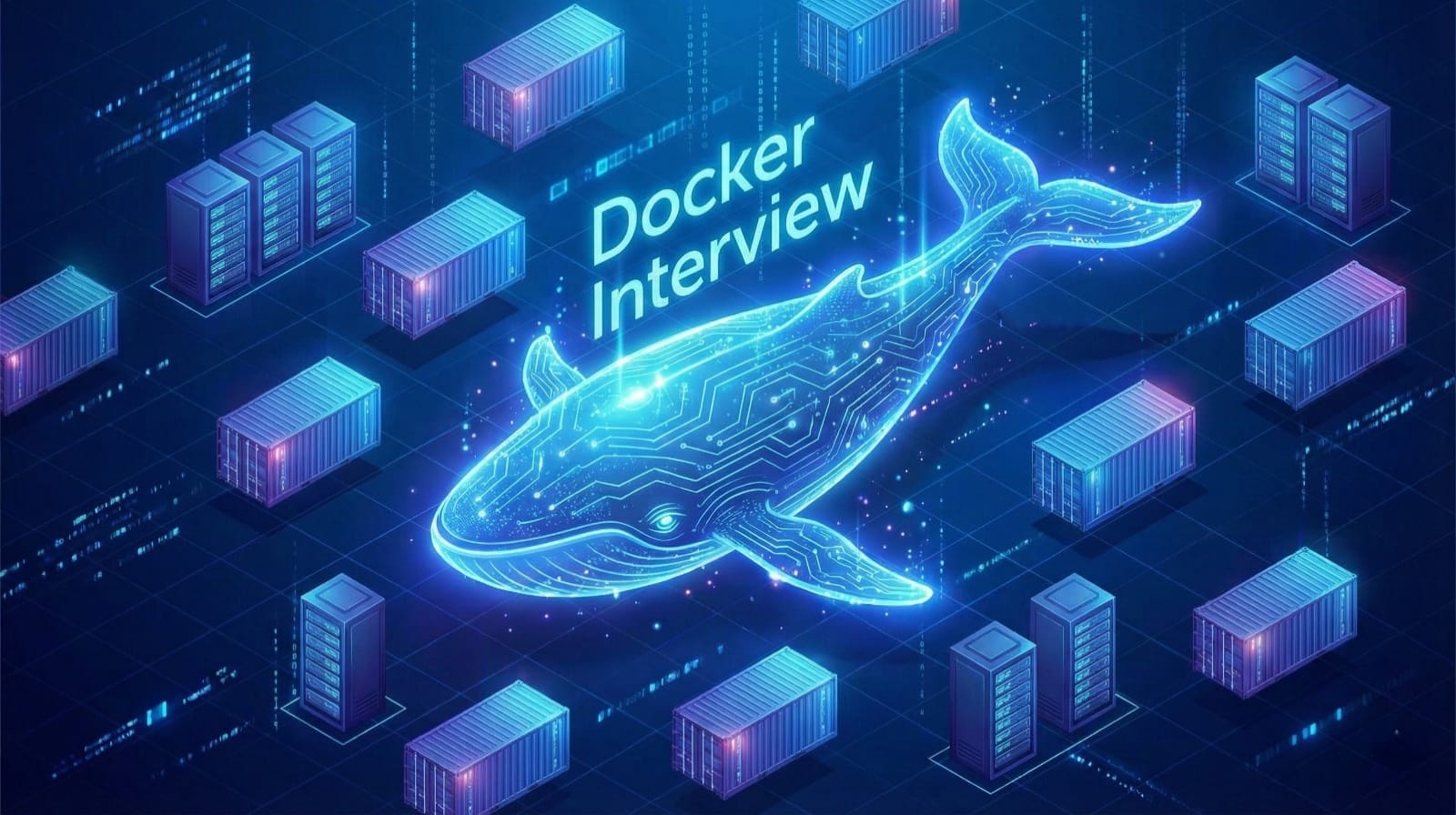
If you are aiming for a career in DevOps or Cloud Engineering in 2026, you cannot ignore Docker. It has become the industry standard for containerization. Consequently, Docker interview questions are now a staple in almost every technical interview process.
Hiring managers want to know that you understand more than just docker run. They want to see that you grasp the architecture, networking, and security best practices that keep modern applications running.
To help you prepare, we have curated this guide of the top Docker interview questions and answers. We cover everything from basic definitions to advanced orchestration concepts.
Basic Docker Interview Questions for Beginners
Let’s start with the fundamentals. These are the Docker interview questions you will likely face in the screening round.
1. What is Docker?
Docker is an open-source platform that utilizes containerization technology to package, distribute, and run applications. It allows developers to bundle an application with all its dependencies into a standardized unit called a container, ensuring it runs smoothly in any environment.
2. What is a Container?
A Container is a lightweight, standalone executable package that includes everything needed to run a piece of software: the code, runtime, system tools, system libraries, and settings. Unlike traditional software, containers run consistently across any system, eliminating the “it works on my machine” problem.
3. Docker vs Virtual Machines (VMs): What is the difference?
This is one of the most classic Docker interview questions.
- Docker Containers: Share the host OS kernel, making them extremely lightweight (megabytes in size) and fast to start (seconds).
- Virtual Machines (VMs): Require a full Operating System (OS) per instance, making them heavier (gigabytes in size) and slower to boot up.
4. What is a Docker Image?
A Docker Image is a read-only template used to create containers. It is like a snapshot of your application. Images are built from a Dockerfile using layers of instructions. When you start an image, it becomes a running container.
5. What are the most common Docker commands?
You should be ready to demonstrate familiarity with the CLI. Common commands include:
- docker run: Start a new container from an image.
- docker build: Create an image from a Dockerfile.
- docker ps: List currently running containers.
- docker images: List all available images on the local machine.
- docker stop: Gracefully stop a running container.
- docker pull: Download an image from a registry.
- docker push: Upload an image to a registry.
Technical Docker Interview Questions on Architecture
Once you pass the basics, the interviewer will ask more specific Docker interview questions about how you build and manage these containers.
6. What is a Dockerfile?
A Dockerfile is a simple text file that contains a set of instructions to automate the creation of a Docker image. It uses keywords like FROM (base image), RUN (execute command), COPY (add files), and CMD (default command) to assemble the image.
7. What is Docker Compose?
Docker Compose is a tool used for defining and running multi-container Docker applications. It uses a YAML file to configure the application’s services, networks, and volumes. With a single command, you can create and start all the services from your configuration.
8. What is Docker Hub?
Docker Hub is the world’s largest public registry for container images. It works similarly to GitHub but for binaries. It allows you to find shared images from other developers and official vendors, as well as store and share your own images.
9. What is Docker Swarm?
Docker Swarm is Docker’s native clustering and orchestration tool. It allows you to manage a “swarm” of Docker nodes (multiple servers) as a single virtual system, handling the scheduling and deployment of services across the cluster.
10. What are Docker Volumes?
Docker Volumes are the preferred mechanism for persisting data generated by and used by Docker containers. Since containers are ephemeral (data is lost when they stop), volumes allow you to store data on the host filesystem so it survives the container lifecycle.
Advanced Docker Interview Questions (Networking & Security)
For senior roles, expect these tough Docker interview questions.
11. What is Docker Networking?
Docker Networking is the native feature that allows containers to communicate with each other and the outside world. Common networking modes include:
- Bridge: The default network for containers.
- Host: Removes network isolation between the container and the host.
- Overlay: Used for communicating across a Swarm cluster.
- None: Disables all networking.
12. How do you build a Docker Image?
To build an image, you navigate to the directory containing your Dockerfile and run:
docker build -t image-name .
The -t flag allows you to tag the image with a friendly name for easy reference later.
13. What is the difference between CMD and ENTRYPOINT?
- CMD: Sets default arguments for the executable. These can be easily overridden by the user when running the container.
- ENTRYPOINT: Configures a container that will run as an executable. Arguments passed to docker run are appended to the entrypoint command rather than overriding it.
14. What is Container Orchestration?
Container Orchestration refers to the automated management of container lifecycles at scale. Tools like Kubernetes and Docker Swarm handle tasks such as provisioning, deployment, scaling (up or down), networking, and load balancing.
15. How do you handle Docker Security?
Security is a critical topic in Docker interview questions. Best practices include:
- Running containers as a non-root user.
- Scanning images for vulnerabilities using tools like Trivy.
- Using minimal base images (like Alpine Linux) to reduce the attack surface.
- Limiting container privileges.
- Keeping the Docker engine and host OS updated.
Conclusion
Mastering these Docker interview questions is the first step toward landing your dream DevOps job. Remember to practice these commands in your own terminal to build muscle memory.
Check out our guide on Git Interview Questions
Ready to start your DevOps journey? Download Docker Desktop today and start building!