10 Advanced Top DSA Interview Questions with Answers: Part-2
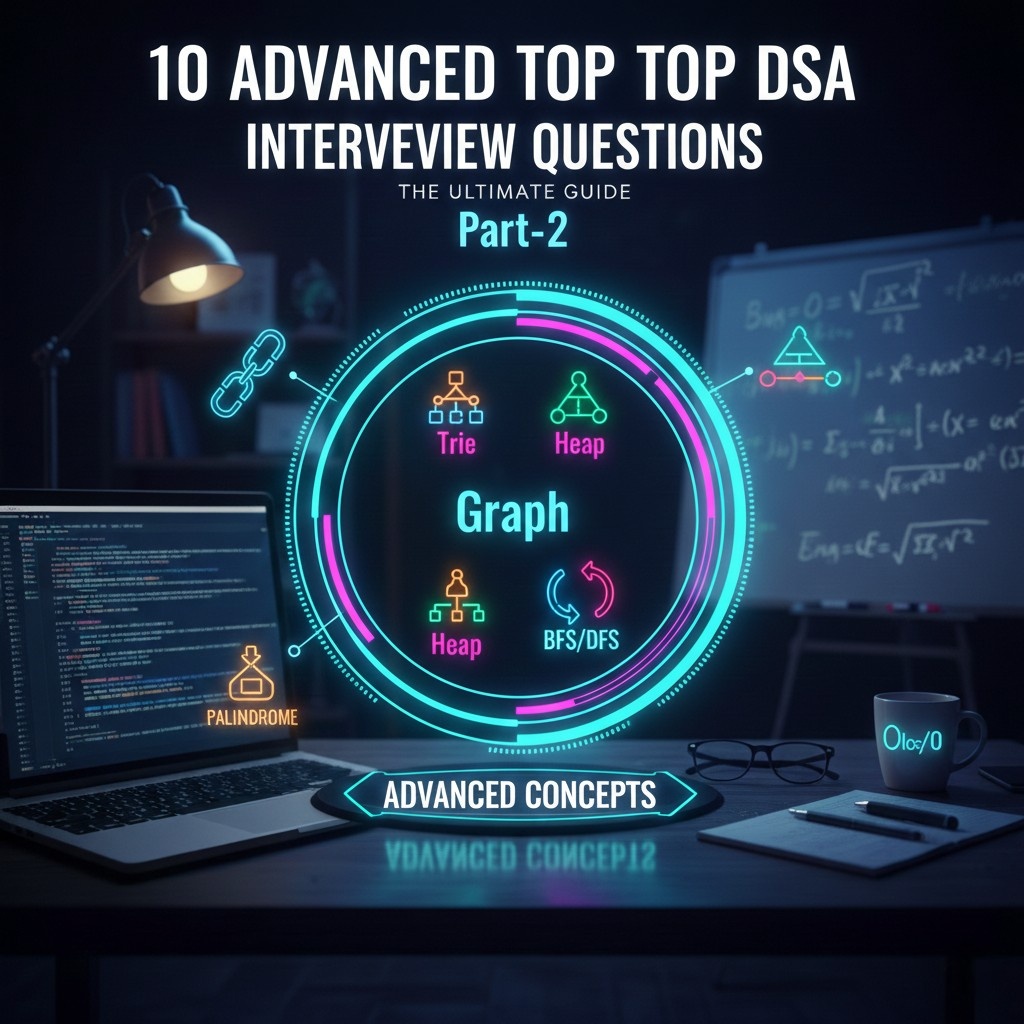
Following up on our basic guide, this second installment of Top DSA Interview Questions with Answers dives into complex structures like Graphs, Tries, and the logic of Dynamic Programming. If you want to crack interviews at companies like Google, Amazon, or Microsoft, mastering these concepts is the ultimate requirement.
11. What is the difference between BFS and DFS?
Graph traversal is a core topic in any technical interview.
- BFS (Breadth-First Search): Explores all neighbor nodes at the present depth before moving to nodes at the next depth level. It uses a Queue data structure.
- DFS (Depth-First Search): Starts at the root and explores as far as possible along each branch before backtracking. It uses a Stack (or recursion).
- Key Use Case: BFS is ideal for finding the shortest path in an unweighted graph, while DFS is great for cycle detection and topological sorting.
12. What is a Heap?
A Heap is a specialized, complete binary tree.
- Max-Heap: The value of the parent node is always greater than or equal to the values of its children. The root is the maximum element.
- Min-Heap: The value of the parent node is less than or equal to its children. The root is the minimum element.
- Why use it? Heaps allow for O(1) access to the max/min element and O(log n) insertion, making them perfect for Priority Queues.
13. What is a Trie?
A Trie (pronounced “try”), also known as a prefix tree, is an ordered tree data structure used to store a dynamic set or associative array where the keys are usually strings.
- Functionality: Each node represents a single character of a word.
- Real-world Apps: Autocomplete in search engines, spell-checkers, and IP routing.
14. What is a Graph?
A Graph is a non-linear data structure consisting of Vertices (Nodes) and Edges (Lines) that connect these vertices.
- Representation: Graphs can be represented using an Adjacency Matrix (2D array) or an Adjacency List (array of lists).
- Usage: Modelling social networks, Google Maps (pathfinding), and recommendation engines.
15. Difference between Directed and Undirected Graph?
- Directed Graph (Digraph): Edges have a specific direction. If there is an edge from A to B, you cannot travel from B to A unless another edge exists. (Example: Twitter followers).
- Undirected Graph: Edges are bidirectional. An edge between A and B means you can move both ways. (Example: Facebook friends).
16. Time Complexity: Arrays vs. Linked Lists
Interviewers love to test your knowledge of efficiency.
Operation | Array (Static) | Linked List |
Random Access | O(1) | O(n) |
Insert/Delete at Start | O(n) | O(1) |
Insert/Delete at End | O(1) | O(n) |
Search | O(n) | O(n) |
17. What is Recursion?
Recursion is a programming technique where a function calls itself to solve a larger problem by breaking it down into smaller, manageable sub-problems.
- Danger: Without a proper exit strategy, recursion leads to a StackOverflowError.
- Common Problems: Tower of Hanoi, Factorial calculation, and Tree traversals.
18. What are Base Case and Recursive Case?
Every recursive function must have two parts:
- Base Case: The condition under which the function stops calling itself.
- Recursive Case: The logic where the function calls itself with a modified argument, moving closer to the base case.
19. What is Dynamic Programming (DP)?
Dynamic Programming is an algorithmic technique used to solve complex problems by breaking them into overlapping subproblems.
- The Key: It follows the principle of “storing, not recomputing.” If you’ve solved a subproblem once, you save the answer for future use.
- Classic Example: Calculating Fibonacci numbers efficiently.
20. Difference between Memoization and Tabulation?
These are the two primary ways to implement DP:
- Memoization (Top-Down): You start with the main problem and break it down. You use recursion and a cache (like a Hashmap) to store results.
- Tabulation (Bottom-Up): You start by solving the smallest subproblems first and fill up a table (usually an array) iteratively until you reach the main problem.
Where to Practice: Top DSA Platforms
Knowledge is only half the battle; the other half is implementation. Here are the gold-standard platforms to hone your skills:
Industry Leaders
- LeetCode: The most popular choice for interview prep. It features thousands of problems categorized by difficulty and specific company tags (Google, Amazon, Meta).
- HackerRank: Excellent for beginners. Its structured “Skill Certification” and “10 Days of Statistics/JS/SQL” tracks help build a solid foundation.
- GeeksforGeeks: The “Wikipedia of Computer Science.” It offers an massive problem set alongside detailed articles explaining the logic behind every solution.
Pattern-Based & Mock Practice
- InterviewBit: Uses a gamified, time-bound approach that simulates the pressure of a real interview.
- NeetCode: A curated list of LeetCode problems (the “NeetCode 150”) with high-quality video explanations for each.
- Pramp: A unique platform that pairs you with other developers for free mock peer-to-peer interviews.
Competitive Coding (Advanced)
- Codeforces: Best for those looking to reach “Grandmaster” levels of logic and speed.
- CodeChef: Hosts monthly contests that are highly regarded by top-tier product companies.
Deep Dive: More Interview Prep Guides
Ready to level up even further? Check out our other step-by-step guides to ensure you are fully prepared for every round of your technical interview:
- JavaScript Interview Cheat Sheet: Ace Your Frontend Rounds – Master Scope, Hoisting, and the Event Loop with these high-frequency questions.
- 10 Killer Computer Science Projects to Land a Job in 2026 – Stand out from the crowd by building these industry-relevant projects.
- Docker Interview Questions & Answers – A complete guide to mastering containerization concepts for DevOps and Backend roles.
- JavaScript Polyfills Cheat Sheet – Learn how to write your own versions of map, filter, and reduce from scratch.