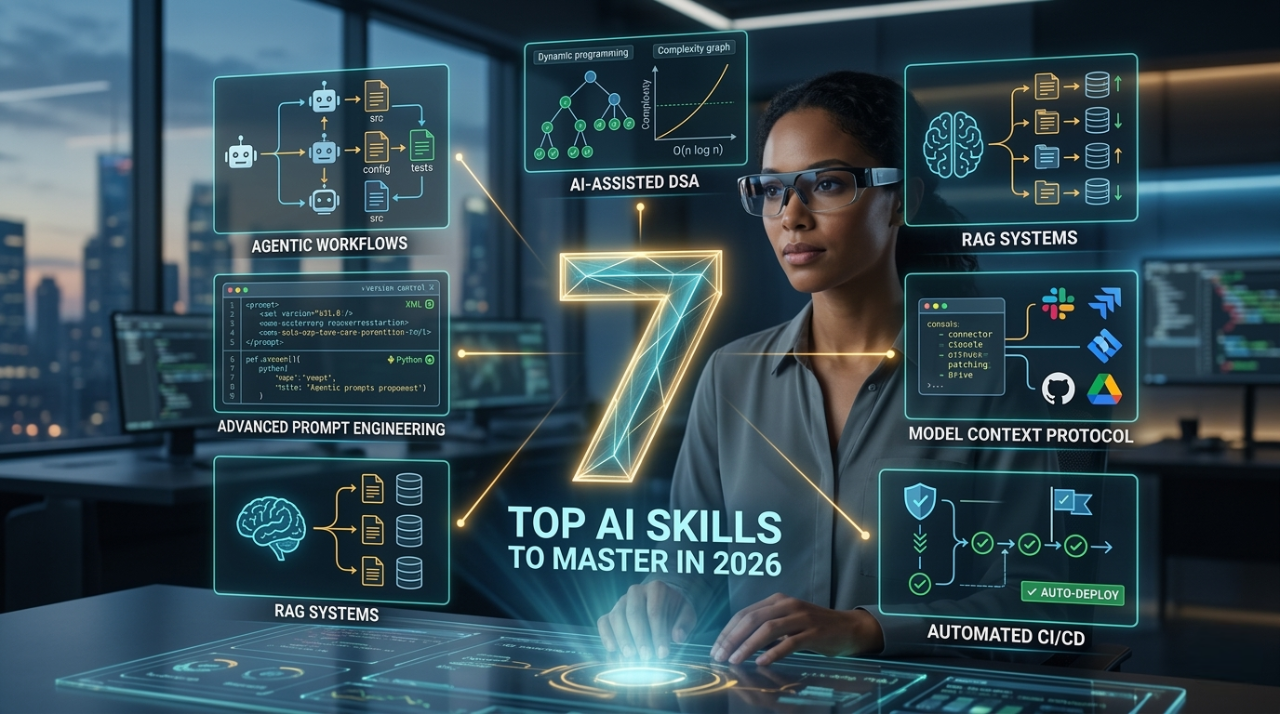
7 AI Skills You Must Master in 2026 to Stay Ahead of Everyone.
Remember when basic code autocomplete felt like absolute magic? The technology landscape is shifting faster than ever, and those days are already in the rearview mirror. If you want to stay relevant as a developer or tech professional, mastering the Top AI Skills is no longer just optional it is your lifeline.
We have officially moved past basic code completion and simple chatbot prompts. Today, the tech industry demands engineers who can architect, supervise, and orchestrate complex, autonomous artificial intelligence systems.
Learning these Top AI Skills will drastically reduce your development time, turning week-long sprints into afternoon tasks. More importantly, they will give you a massive competitive edge during technical interviews and architectural planning. This guide breaks down the exact competencies you need to learn. To make this easy to digest, every concept is broken down into short, highly actionable points.
Why Mastering the Top AI Skills Changes Everything
The days of manually typing out every single line of boilerplate architecture are over. Modern software engineering is rapidly shifting away from raw typing and moving heavily toward high-level problem-solving and system design.
By building these Top AI Skills, you transition from being a standard, manual programmer to a high-leverage AI orchestrator. Companies are actively testing for these precise competencies because they know an AI-fluent engineer can do the work of a whole team. Let us dive into the seven critical areas you absolutely must focus on this year.
1. Agentic Workflow Orchestration
AI agents are systems that can plan, reason, and execute multi-step tasks autonomously. Imagine having a tireless junior developer who never sleeps.
- What it is: This involves moving beyond single-prompt chatbots to multi-agent systems that read, plan, and write structural changes across your entire repository all at once.
- Why it matters: It automates massive refactoring tasks. Instead of hunting down variable changes in fifty different files, an agent handles the entire migration in one sweep.
- How to learn it: Focus on the theory behind frameworks like LangChain or AutoGen. Understand how agents are given tools and how they logically decide which tool to use next.
- Quick Tip: In interviews, discuss how you use autonomous agents to handle repetitive CRUD operations and database migrations conceptually.
2. Advanced Prompt Engineering
This remains a foundational pillar among the Top AI Skills. It is not just about asking questions; it is about strictly structuring context.
- What it is: Using precise syntax, logical constraints, and deep system prompts to get exact, secure, and highly predictable outputs from large language models.
- Why it matters: Ambiguous prompts lead to hallucinations and buggy logic. Precision is what separates a toy application from enterprise software.
- How to learn it: Study the theory of few-shot prompting, chain-of-thought reasoning, and how to effectively use XML tagging to segment your instructions from your data context.
- Quick Tip: Always outline your exact technology stack versions, architectural patterns, and design constraints conceptually before asking an AI to solve a problem.
3. RAG (Retrieval-Augmented Generation)
LLMs are brilliant, but they do not inherently know your proprietary company data. RAG is the bridge that solves this massive limitation.
- What it is: Connecting a language model to an external knowledge base (like a vector database) so it can retrieve accurate, real-time context before generating an answer. Think of it as giving the AI an open-book test.
- Why it matters: It completely prevents the AI from making up false information (hallucinations) and grounds its reasoning in your actual business logic.
- How to learn it: Study the conceptual pipeline of how documents are chunked, converted into mathematical vectors, stored, and then retrieved via semantic search when a user asks a question.
- Quick Tip: RAG architectures are highly requested system design interview topics right now. Master the high-level data flow!
Read more about vector embeddings on the official OpenAI documentation
4. AI-Assisted Data Structures & Algorithms
Algorithms are the invisible backbone of efficient software. Integrating AI into this domain is a crucial, often-overlooked addition to the Top AI Skills.
- What it is: Using AI as a theoretical sparring partner to analyze time complexity (Big O), optimize hashing strategies, or conceptualize dynamic programming solutions.
- Why it matters: It drastically deepens your understanding of core computer science fundamentals without getting bogged down in syntax errors.
- How to learn it: Take a brute-force sorting or tree-traversal concept and ask an AI to explain how to optimize it for spatial efficiency theoretically.
- Quick Tip: Use AI as a mock interviewer. Have it present you with a graph traversal problem and ask it to critique your logic step-by-step before you ever touch a keyboard.
5. Model Context Protocol (MCP) Integration
MCP is completely revolutionizing how developer tools talk to each other, acting as a universal translator.
- What it is: An open standard that allows your AI assistants to securely and natively connect to external tools like Slack, Jira, or Google Drive.
- Why it matters: It completely removes the friction of constantly copying and pasting context between forty different browser tabs. The AI brings the context directly to your workspace.
- How to learn it: Understand the conceptual architecture of setting up an MCP server that acts as a secure read-only bridge to your local database schema or API documentation.
- Quick Tip: Mentioning theoretical MCP integrations shows hiring managers that you are looking at the absolute bleeding edge of the technology curve.
6. AI Security and Vulnerability Auditing
Because AI writes code incredibly fast, the risk of it generating vulnerabilities also increases. Security is a highly required addition to your list of Top AI Skills.
- What it is: Utilizing specialized AI models to conceptually scan your application’s logic for injection flaws, memory leaks, and complex authorization bypasses.
- Why it matters: Traditional static analysis tools often miss the nuanced, complex business-logic bugs that a context-aware AI can easily catch.
- How to learn it: Study the theoretical ways applications fail (like insecure direct object references) and explore how to instruct an AI to act as a “Red Team” auditor to find those theoretical holes.
- Quick Tip: Never blindly trust AI-generated authentication loops. Always use a secondary AI prompt specifically designed to hunt for security flaws in that exact logic.
7. Automated CI/CD AI Integration
Deployment should be a smooth, frictionless, and autonomous experience that doesn’t ruin your Friday afternoon.
- What it is: Hooking AI agents directly into your Continuous Integration and Continuous Deployment pipelines (like GitHub Actions or Jenkins).
- Why it matters: It automates the tedious parts of code reviews, instantly generates pull request summaries, and flags theoretical breaking changes before they merge.
- How to learn it: Study how API webhooks can trigger an AI to conceptually analyze a diff and post a summary of the architectural impact back to the development team.
- Quick Tip: Engineering teams heavily favor candidates who know how to reduce the friction of code reviews and speed up deployment velocity.
Building Your Capabilities for Interviews
Acquiring the Top AI Skills is only the first half of the battle; effectively articulating them is the second.
When you sit down for your next technical screening, do not just talk about which new framework you used. Discuss the high-level architecture. Explain how you theoretically used RAG to reduce latency in a system. Detail how you structured an advanced prompt to optimize a complex recursive function safely.
Check out our previous blog: Why Claude Code Can Be Dangerous. Click here to read it.
Final Thoughts
The development world is moving at lightning speed, and those who adapt will lead the next generation of tech. By focusing on these core concepts—from agentic workflows to secure deployment you completely future-proof your career. Start small. Pick one theoretical concept from this list, map out how it works on a whiteboard, and expand your knowledge from there. Master the Top AI Skills today, and you will be fully ready to architect the software of tomorrow.