10 Essential Top DSA Interview Questions with Answers: Part-3
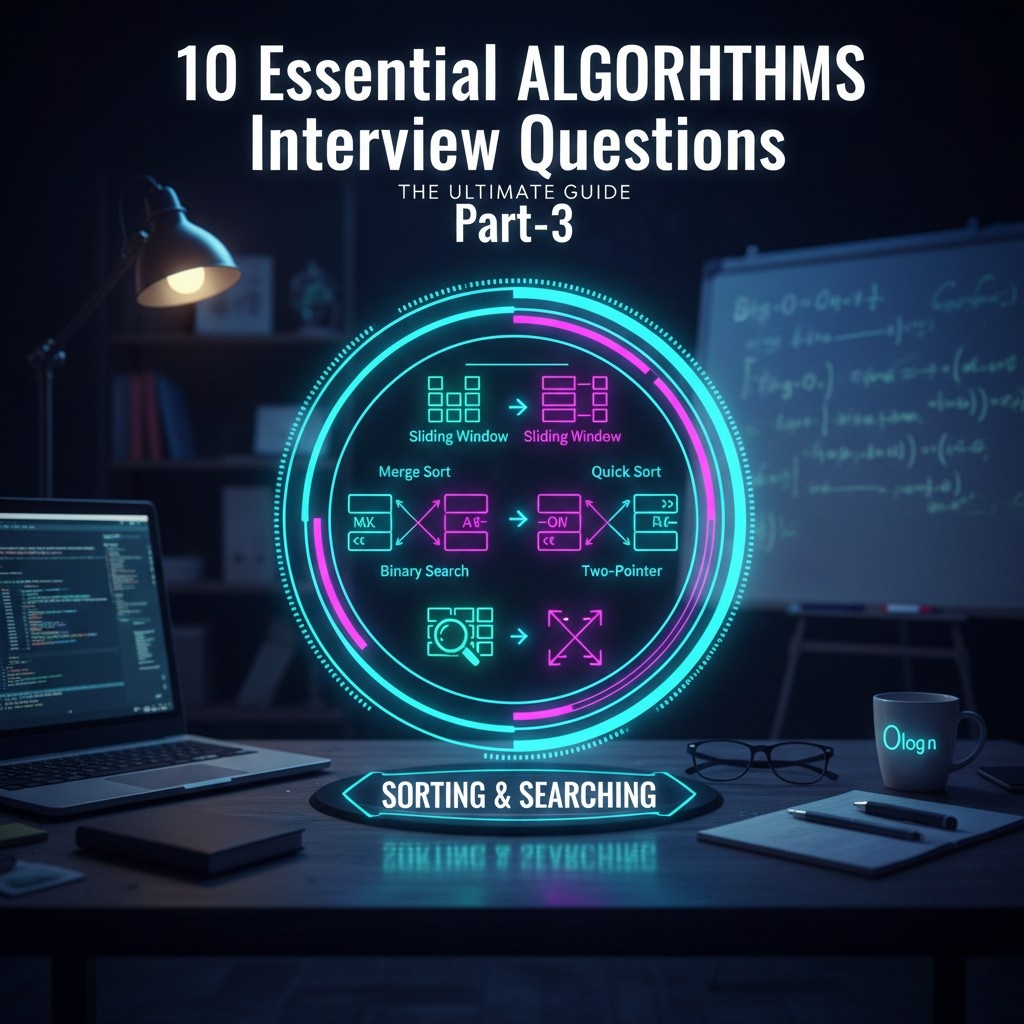
Welcome to Part-3 of our series! While Parts 1 and 2 focused on how to store data, this guide focuses on how to process it. Mastering these sorting and searching algorithms is crucial for answering Top DSA Interview Questions with Answers effectively.
21. What is the Sliding Window technique?
The Sliding Window is a frequently asked topic in lists of Top DSA Interview Questions with Answers. It is an optimization pattern used to convert nested loops (O(n^2)) into a single loop (O(n)). You maintain a “window” (defined by two pointers) that expands or shrinks as it moves across an array or string.
- Fixed Window: Finding the maximum sum of k consecutive elements.
- Variable Window: Finding the smallest subarray with a sum geq X.
- Why Interviewers Love It: It demonstrates your ability to optimize “brute force” solutions.
22. Explain the Two-Pointer technique.
Another staple in Top DSA Interview Questions with Answers, this technique uses two variables (pointers) to keep track of indices. They usually move toward each other (from ends to middle) or in the same direction at different speeds (Fast & Slow pointers).
- Opposite Ends: Checking if a string is a palindrome or finding a pair that sums to a target in a sorted array.
- Same Direction: Removing duplicates from a sorted array or detecting a cycle in a linked list (Floyd’s Cycle-Finding Algorithm).
23. What is the Binary Search algorithm?
Binary Search is often cited as the “King” of search algorithms in Top DSA Interview Questions with Answers. It only works on sorted data. It checks the middle element; if it’s not the target, it discards half the search space and repeats.
- Time Complexity: O(log n)
- Space Complexity: O(1) for iterative, O(log n) for recursive.
- Pro Tip: Always mention that the data must be sorted before applying Binary Search.
24. What is the Merge Sort algorithm?
Merge Sort is a stable, comparison-based sorting algorithm frequently appearing in Top DSA Interview Questions with Answers. It recursively splits the array into two halves until each subarray has one element, then merges them back in sorted order.
- Stability: Yes (it preserves the relative order of equal elements).
- Drawback: It requires $O(n)$ extra space for the merging process.
25. What is the Quick Sort algorithm?
Quick Sort picks a “pivot” element and partitions the array so that everything smaller than the pivot is on the left and everything larger is on the right. It then repeats this for the sub-arrays.
- Efficiency: It is often faster than Merge Sort in practice due to better cache locality.
- Worst Case: $O(n^2)$ if the pivot is always the smallest or largest element (solved by choosing a random pivot).
26. Difference between Merge Sort and Quick Sort
This comparison is a classic among Top DSA Interview Questions with Answers.
|
Feature |
Merge Sort |
Quick Sort |
|
Space |
O(n) (Extra space) |
O(log n) (In-place) |
|
Stability |
Stable |
Not Stable |
|
Performance |
Consistent O(n log n) |
Fast, but O(n^2) worst case |
|
Best For |
Large datasets, Linked Lists |
Arrays, where space is a concern |
27. What is Insertion Sort?
Insertion Sort works the way you might sort a deck of cards. It takes one element at a time and “inserts” it into its correct position among the already sorted elements.
- Best Case: O(n) when the array is nearly sorted.
- Use Case: Small datasets or when new elements are constantly being added to a sorted list.
28. What is Selection Sort?
Selection Sort repeatedly finds the minimum element from the unsorted part and puts it at the beginning.
- Efficiency: It performs O(n^2) comparisons and O(n) swaps.
- Stability: Not stable.
- Verdict: Generally outperformed by Insertion Sort.
29. What is Bubble Sort and its drawbacks?
Bubble Sort is often the first algorithm taught, but in Top DSA Interview Questions with Answers, it is usually discussed for its inefficiency. It “bubbles up” the largest element to the end of the array by repeatedly swapping adjacent elements.
- Drawback: It is very inefficient for large datasets (O(n^2)).
- Optimization: You can add a swapped flag to stop the algorithm early if the array becomes sorted before the final pass.
30. Sorting Complexity Comparison Table
Memorizing this table is essential for answering complexity-based Top DSA Interview Questions with Answers.
|
Algorithm |
Best Time |
Avg Time |
Worst Time |
Space |
Stable |
|
Bubble Sort |
O(n) |
O(n^2) |
O(n^2) |
O(1) |
Yes |
|
Selection |
O(n^2) |
O(n^2) |
O(n^2) |
O(1) |
No |
|
Insertion |
O(n) |
O(n^2) |
O(n^2) |
O(1) |
Yes |
|
Merge Sort |
O(n log n) |
O(n log n) |
O(n log n) |
O(n) |
Yes |
|
Quick Sort |
O(n log n) |
O(n log n) |
O(n^2) |
O(log n) |
No |
Where to Practice: Top DSA Platforms
Knowledge is only half the battle; the other half is implementation. Here are the gold-standard platforms to hone your skills:
Industry Leaders
- LeetCode: The most popular choice for interview prep. It features thousands of problems categorized by difficulty and specific company tags (Google, Amazon, Meta).
- HackerRank: Excellent for beginners. Its structured “Skill Certification” and “10 Days of Statistics/JS/SQL” tracks help build a solid foundation.
- GeeksforGeeks: The “Wikipedia of Computer Science.” It offers an massive problem set alongside detailed articles explaining the logic behind every solution.
Pattern-Based & Mock Practice
- InterviewBit: Uses a gamified, time-bound approach that simulates the pressure of a real interview.
- NeetCode: A curated list of LeetCode problems (the “NeetCode 150”) with high-quality video explanations for each.
- Pramp: A unique platform that pairs you with other developers for free mock peer-to-peer interviews.
Competitive Coding (Advanced)
- Codeforces: Best for those looking to reach “Grandmaster” levels of logic and speed.
- CodeChef: Hosts monthly contests that are highly regarded by top-tier product companies.
Deep Dive: More Interview Prep Guides
Ready to level up even further? Check out our other step-by-step guides to ensure you are fully prepared for every round of your technical interview:
- JavaScript Interview Cheat Sheet: Ace Your Frontend Rounds – Master Scope, Hoisting, and the Event Loop with these high-frequency questions.
- 10 Killer Computer Science Projects to Land a Job in 2026 – Stand out from the crowd by building these industry-relevant projects.
- Docker Interview Questions & Answers – A complete guide to mastering containerization concepts for DevOps and Backend roles.
- JavaScript Polyfills Cheat Sheet – Learn how to write your own versions of map, filter, and reduce from scratch.