SQL vs. NoSQL: 7 Crucial Differences for Your Ultimate Interview Success
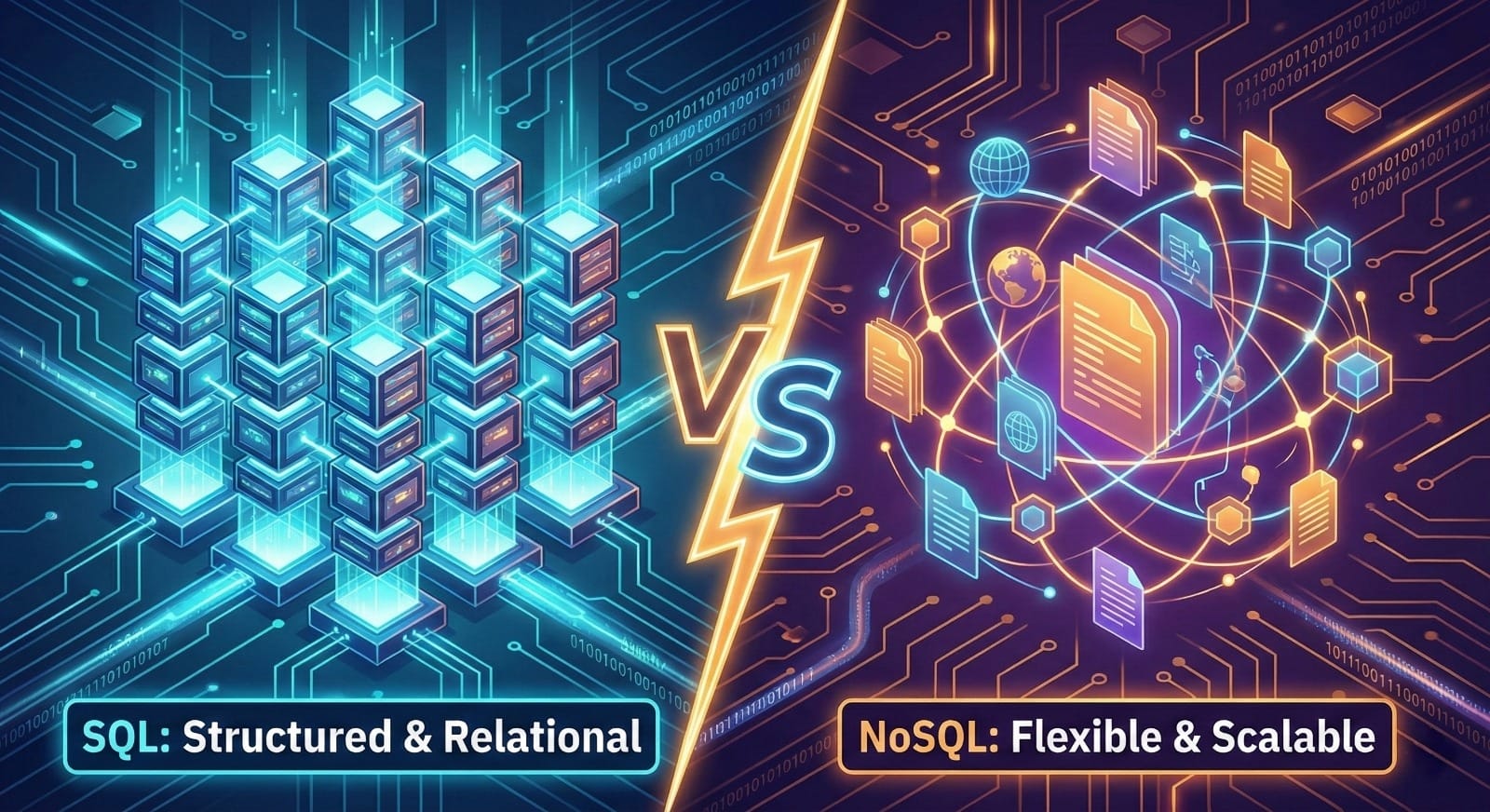
Are you a fresher preparing for a Database Management System (DBMS) interview? If so, you have likely encountered the most famous debate in the database world. Understanding the core concepts of SQL vs. NoSQL is an absolute requirement for cracking technical interviews at top tech companies.
Whether you are applying for a backend developer role, a data analyst position, or a full-stack engineering job, the interviewer will ask you to compare these two technologies.
In this guide, we will break down the history, the technical differences, and the best use cases for both. By the end of this post, you won’t just memorize definitions; you will understand the architecture behind them.
Note to Freshers: Don’t just memorize the table. Understand the why behind the differences to impress your interviewer.
What is SQL?
SQL (Structured Query Language) is the standard language for dealing with Relational Database Management Systems (RDBMS). Think of it as a rigid, well-organized digital filing cabinet. Data is stored in tables with fixed rows and columns.
SQL databases have been the dominant force in data storage for over four decades. They are known for strict adherence to ACID properties (Atomicity, Consistency, Isolation, Durability), which ensures that financial transactions and sensitive data remain accurate and secure.
Popular SQL Examples:
- MySQL
- PostgreSQL
- Oracle Database
- Microsoft SQL Server
What is NoSQL?
NoSQL (often interpreted as “Not Only SQL”) represents a non-relational database. Unlike the rigid tables of SQL, NoSQL databases are flexible. They can store data in various formats, such as documents, key-value pairs, wide-column stores, or graphs.
NoSQL rose to popularity in the late 2000s to handle the massive velocity and variety of “Big Data” generated by social media and mobile apps. If SQL is a filing cabinet, NoSQL is a giant laundry basket—you can throw different things in, and it expands as needed.
Popular NoSQL Examples:
- MongoDB (Document)
- Redis (Key-Value)
- Cassandra (Wide-Column)
- Neo4j (Graph)
SQL vs. NoSQL: The Main Differences
This section is the heart of your interview preparation. When an interviewer asks you to distinguish between the two, this comparison is what they are looking for.
Here is a quick snapshot of the SQL vs. NoSQL battle:
Feature | SQL Databases (Relational) | NoSQL Databases (Non-Relational) |
Structure | Table-based | Document, Key-value, Graph, or Column-based |
Schema | Pre-defined (Static) | Dynamic (Flexible) |
Scalability | Vertical (Scale Up) | Horizontal (Scale Out) |
Query Language | Structured Query Language (SQL) | UnQL (Unstructured Query Language) |
Best For | Complex queries & Multi-row transactions | rapid updates & Unstructured data |
Scalability: Vertical vs. Horizontal
One of the most critical points in the SQL vs. NoSQL discussion is scalability.
SQL databases scale vertically.
Imagine you have a building (your server). If you need more space, you add more floors to the existing building. In technical terms, this means increasing the RAM, CPU, or SSD capacity of the single server hosting your database. There is a limit to how much you can upgrade one machine.
NoSQL databases scale horizontally. Instead of adding floors to one building, you simply buy the building next door. NoSQL allows you to add more servers to your pool of resources (sharding). This approach is the backbone of modern microservices. If you are preparing for a role that involves modern infrastructure, you should also brush up on your containerization knowledge with our guide on Docker Interview Questions.
Schema Structure and Flexibility
When discussing SQL vs. NoSQL, the concept of “Schema” is vital.
- SQL requires a defined schema. Before you enter data, you must define the structure. If you have a “Users” table with Name, Age, and Email, you cannot suddenly add a Favorite Color for just one user without altering the entire table structure.
- NoSQL is schema-less. You can treat data like a dynamic JSON document. One user document can have Name and Email, while the next user document can have Name, Email, and Twitter Handle. This flexibility allows developers to iterate faster without running complex migration scripts.
When to Choose SQL vs. NoSQL?
In your interview, you might be given a scenario and asked to choose a database. Here is how to decide.
Choose SQL when:
- Data Consistency is critical: Banking apps, accounting software, or inventory management where ACID compliance is non-negotiable.
- The data structure is stable: You know your data requirements won’t change drastically.
- Complex relationships exist: If you need to join multiple tables frequently to get insights.
Choose NoSQL when:
- Big Data requirements: You are dealing with terabytes of data that need to be distributed.
- Unstructured data: You are storing social media posts, logs, or sensor data that varies in format.
- Rapid prototyping: You are a startup and the data model is still evolving.
Check out this resource on Modern Database Architecture to see how big tech companies mix these technologies.
Common Interview Questions
To wrap up this SQL vs. NoSQL guide, here are three specific questions you should prepare for:
- “Can NoSQL databases support ACID transactions?”
- Answer: Traditionally, NoSQL focused on BASE (Basically Available, Soft state, Eventual consistency). However, modern NoSQL databases like MongoDB now offer multi-document ACID transactions, though SQL is still the gold standard for strict consistency.
- “Why is NoSQL faster than SQL for large datasets?”
- Answer: Because NoSQL uses horizontal scaling and often avoids complex “JOIN” operations. It retrieves data from a single document rather than stitching together data from five different tables.
- “Which is better for a chat application: SQL or NoSQL?”
- Answer: NoSQL (specifically Cassandra or MongoDB) is usually better because chat logs grow infinitely, are unstructured, and require high write speeds.
Conclusion
The debate of SQL vs. NoSQL isn’t about one being “better” than the other. It is about choosing the right tool for the job. SQL is the king of structure and reliability, while NoSQL is the master of speed and flexibility.
As a fresher, demonstrating that you understand these trade-offs will set you apart from other candidates.
Ready to practice? Don’t just read about the differences—experience them. I have curated two excellent installation guides for you:
For SQL: Install Microsoft SQL Server on Windows 11 to practice your JOINs and schema design.
For NoSQL: Install MongoDB & Compass to try out flexible JSON-like document storage.
Set these up, create a simple “Student” database in both, and try to query the data. This hands-on experience will give you the confidence to discuss SQL vs. NoSQL fluently in your next interview!