
Data Types in C++
Data types define the nature of data that can be stored and manipulated in a program.
Primary (Built-in) Data Types
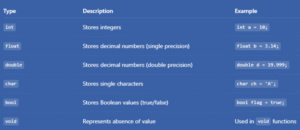
General Syntax:
data_type variable_name = value;
Example:
int age = 25;
float pi = 3.14;
char grade = ‘A’;
bool isValid = true;
Derived Data Types
Derived types are constructed from built-in types. These include:
- Array: Collection of elements of the same type.
Example: int numbers[5] = {1, 2, 3, 4, 5};
- Function: A block of code that performs a specific task.
Example: int add(int a, int b) { return a + b; }
- Pointer: Stores the memory address of another variable.
Example: int *ptr = &age;
- Reference: Provides an alias for a variable.
Example: int& ref = age;
User-Defined Data Types
Users can define their own data types using:
- Structure (struct): Combines different data types.
Example:
struct Student {
int id;
char name[30]; };
- Union (union): Shares memory between variables.
Example:
union Data {
int i;
float f; };
- Enumeration (enum): Defines a set of named constants.
Example:
enum Color {
RED, GREEN, BLUE };
- Class: Defines objects with data and functions.
Example:
class Car {
public: int speed;
void drive(); };