
Constants in C++
Constants in C++ Constants in C++ refer to fixed values that cannot be changed once assigned, ensuring data integrity throughout the program’s execution. The const keyword is typically used to declare such variables, allowing the compiler to enforce immutability.
General Syntax:
const <data_type> <constant_name> = <value>;
Example:
const float PI = 3.14;
const int MAX_SIZE = 100;
Types of Constants
- Integer Constants: Whole numbers without fractional part.
Example:-
const int a = 10;
- Floating-point Constants: Numbers with a decimal point.
Example:-
const float pi = 3.14159;
- Character Constants: Single character enclosed in single quotes.
Example:-
const char grade = ‘A’;
- String Constants: Sequence of characters enclosed in double quotes.
Example:-
const char* name = “John”;
- Enumeration Constants: Used to declare a group of named integer constants.
Example:-
enum Color { RED, GREEN, BLUE };
Color c = RED;
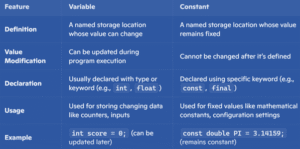
Differences between Variables and Constants
Advantages of Using Constants
- Prevents Accidental Modification
Constants safeguard important values from being unintentionally changed during program execution. - Improves Code Readability
Descriptive constant names make the code easier to understand, especially when compared to raw values. - Ideal for Configuration Settings
Constants are useful for storing settings like limits or system configurations that shouldn’t change. - Maintains Consistency
Using a single constant across the code ensures uniformity and prevents mismatches. - Simplifies Updates
Changing the constant in one place updates all instances where it is used, reducing maintenance effort.
Applications of Variables and Constants
- Used in mathematical calculations.
- Essential for user input/output handling.
- Used in control flow like loops and conditions.
- Constants are used for defining limits and configuration.
- Widely used in real-time embedded programming.
- Critical in database and game development for managing data.
Limitations
- Improper naming can reduce code clarity.
- Memory issues may arise if variables are not properly scoped.
- Overuse of global variables can lead to tight coupling.
- Constants need to be recompiled for changes.
- Too many constants can clutter code.
- Incorrect type usage may lead to data loss or errors.