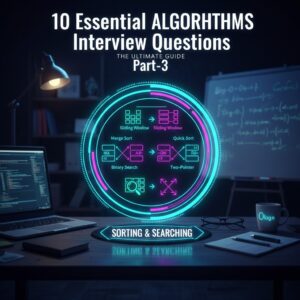
🔥 Top 15 Algorithms Every Developer Should Know in 2025
> These algorithms are not just for interviews — they’re used in databases, networks, game engines, AI, compilers, and real-world systems.
1️⃣ Binary Search 🔍
What: Quickly finds an item in a sorted array by halving the search space.
Time Complexity: O(log n)
Application:
Searching in sorted arrays or files
Lower/upper bound finding in libraries
Real-time games (e.g., hit detection precision)
2️⃣ Merge Sort 🔗
What: Uses the divide-and-conquer strategy to sort arrays.
Time Complexity: O(n log n)
Application:
External sorting (e.g., sorting data on disk)
Linked lists (due to stable and predictable behavior)
Inversion count problems
3️⃣ Quick Sort ⚡
What: Picks a pivot, partitions the array, and recursively sorts.
Time Complexity: Average: O(n log n), Worst: O(n²)
Application:
Built-in language sorting (e.g., Python, JavaScript)
In-memory large data sorting
Used in databases like MySQL for sorting results
4️⃣ Dijkstra’s Algorithm 🧭
What: Finds the shortest path from a source in a weighted graph.
Time Complexity: O((V + E) log V) with a priority queue
Application:
GPS & Maps
Game AI pathfinding
Network routing (e.g., OSPF protocol)
5️⃣ Breadth-First Search (BFS) 🌐
What: Explores neighbor nodes level by level in graphs/trees.
Time Complexity: O(V + E)
Application:
Shortest path in unweighted graphs
Web crawlers, social network analysis
AI bots (e.g., Pac-Man movements)
6️⃣ Depth-First Search (DFS) 🧩
What: Explores as far down as possible before backtracking.
Time Complexity: O(V + E)
Application:
Maze solving, puzzle games
Detecting cycles in graphs
Topological sorting
7️⃣ Dynamic Programming (DP) 📦
What: Solves overlapping subproblems using memoization/tabulation.
Time Complexity: Varies, but always more efficient than recursion.
Application:
Resource allocation (Knapsack problem)
Text correction (edit distance)
Stock buy/sell, sequence alignment in bioinformatics
8️⃣ Greedy Algorithm 🎯
What: Makes locally optimal choices hoping for a global optimum.
Time Complexity: Varies
Application:
Huffman coding (data compression)
Minimum spanning tree (Prim’s, Kruskal’s)
Activity selection, job scheduling
9️⃣ Backtracking ♻
What: Recursively tries all solutions and backtracks on failure.
Time Complexity: Exponential in worst case
Application:
Solving Sudoku, crosswords, N-Queens
Permutations and combinations
Decision trees in games
🔟 Kruskal’s Algorithm 🌲
What: Builds Minimum Spanning Tree (MST) by choosing shortest edges.
Time Complexity: O(E log E)
Application:
Network design (e.g., laying cables with minimum cost)
Clustering algorithms in machine learning
Circuit design optimizations
1️⃣1️⃣ Prim’s Algorithm 🏗
What: Grows MST by adding nearest vertices to the tree.
Time Complexity: O(V²) or O(E log V) with heap
Application:
Network cable layouts
Urban road networks
Approximation algorithms for NP problems
1️⃣2️⃣ Topological Sort 🧮
What: Linear ordering of vertices in a Directed Acyclic Graph (DAG).
Time Complexity: O(V + E)
Application:
Task scheduling (e.g., course prerequisites)
Build systems (e.g., Make, Gradle)
Resolving dependencies (e.g., compilers, package managers)
1️⃣3️⃣ Sliding Window 🪟
What: Optimizes problems involving subarrays or substrings.
Time Complexity: O(n)
Application:
Maximum/minimum sum subarrays
String pattern detection (e.g., anagrams, palindromes)
Real-time analytics (e.g., moving averages)
1️⃣4️⃣ Two Pointer Technique ↔
What: Uses two pointers to solve problems in linear time.
Time Complexity: O(n)
Application:
Pair sum in sorted arrays
Removing duplicates
Reversing arrays, checking palindromes
1️⃣5️⃣ Hashing 🧠
What: Maps data using hash functions for O(1) average-time operations.
Time Complexity: Insert/Search: O(1) average, O(n) worst
Application:
Caching (e.g., LRU cache)
Duplicate detection
Language compilers (symbol tables)
💡 Final Tips for Developers:
🛠 Always understand when and why an algorithm works.
🔁 Practice on platforms like LeetCode, HackerRank, Codeforces.
📊 Visualize algorithms using tools like [VisuAlgo](https://visualgo.net/)
🧠 Mastering algorithms improves not just coding, but problem-solving mindset.