
Different types of Greedy Algorithms
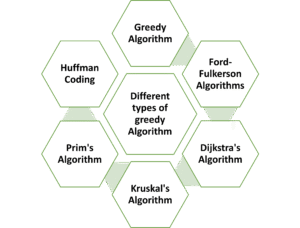
- Ford-Fulkerson Algorithms
The Ford-Fulkerson algorithm is a Greedy and Graph-based algorithm used to find the maximum flow in a flow network from a source node (s) to a sink node (t).
It works by finding augmenting paths in the residual graph and increasing the flow along these paths until no more augmenting paths are available.
Key Concepts:
- Flow Network: A directed graph where each edge has a capacity and carries a flow.
- Residual Graph: Shows the remaining capacity of edges after flow is applied.
- Augmenting Path: A path from source to sink where additional flow can be pushed.
- Bottleneck Capacity: Minimum capacity on an augmenting path (limits the flow you can add).
Working (Step-by-Step):
- Initialize all flows to 0.
- While an augmenting path exists from s to t in the residual graph:
- Find the minimum residual capacity (bottleneck) along the path.
- Add this capacity to the flow of each edge in the path.
- Update the residual graph accordingly (forward and reverse edges).
- Repeat until no more paths are found.
Example:
Imagine a graph like this:
Source → A → Sink
10 5
- Capacity of Source→A = 10
- Capacity of A→Sink = 5
- First augmenting path: Source → A → Sink
Bottleneck = min (10, 5) = 5
Flow is increased by 5.
No more augmenting paths → Done.
Maximum flow = 5
Ford-Fulkerson Algorithm (Max Flow) Python code:
def ford_fulkerson(graph, source, sink):
max_flow = 0
while True:
path, flow = find_augmenting_path(graph, source, sink)
if not path:
break
for u, v in path:
graph[u][v] -= flow
graph[v][u] += flow
max_flow += flow
return max_flow
Time Complexity:
- O (E × max_flow), where E = number of edges
Advantages:
- Conceptually simple and powerful.
- Works on any graph with non-negative edge capacities.
Limitations:
- May not run in polynomial time if irrational capacities are used.
- Needs improvement (like using BFS in Edmonds-Karp) to ensure efficiency.
- Dijkstra’s Algorithm
Dijkstra’s Algorithm is a Greedy algorithm used to find the shortest path from a source vertex to all other vertices in a weighted graph with non-negative edge weights.
It works by repeatedly selecting the vertex with the minimum distance and updating the distances of its adjacent vertices.
Key Properties:
- Works only for graphs with non-negative weights
- Suitable for single-source shortest path
- Based on greedy choice of minimum distance
Step-by-Step Working:
- Set distance of source node to 0 and all others to infinity.
- Add all nodes to a priority queue or min-heap.
- While queue is not empty:
- Pick the node with the minimum distance.
- For each neighbour, calculate new distance.
- If new distance < old distance, update it.
Example Graph:
Vertices: A, B, C, D, E
Edges:
A → B (4), A → C (1)
C → B (2), B → D (1), C → D (5), D → E (3)
Source: A
Shortest Path from A:
|
Vertex |
Distance |
|
A |
0 |
|
B |
3 |
|
C |
1 |
|
D |
4 |
|
E |
7 |
Dijkstra’s Algorithm (Shortest Path) python code:
import heapq
def dijkstra(graph, start):
dist = {v: float(‘inf’) for v in graph}
dist[start] = 0
pq = [(0, start)]
while pq:
cost, u = heapq.heappop(pq)
for v, weight in graph[u]:
if dist[v] > cost + weight:
dist[v] = cost + weight
heapq.heappush(pq, (dist[v], v))
return dist
Time Complexity:
- Using priority queue (heap): O((V + E) log V)
- Kruskal’s Algorithm
Kruskal’s Algorithm is a Greedy Algorithm used to find the Minimum Spanning Tree (MST) of a connected, undirected, and weighted graph.
It works by sorting all edges in ascending order of weight and adding the smallest edge to the spanning tree without forming a cycle, until the tree has (V – 1) edges.
Key Concepts:
- MST: A tree that connects all vertices with the minimum total weight and no cycles.
- Uses Disjoint Set (Union-Find) to detect cycles.
- Greedy: Always picks the lightest available edge.
Step-by-Step Working:
- Sort all edges in non-decreasing order of weight.
- Initialize each vertex as a separate component.
- Pick the smallest edge and check if it forms a cycle using Union-Find:
- If it doesn’t form a cycle, include it in the MST.
- If it forms a cycle, skip it.
- Repeat until (V – 1) edges are included in the MST.
Example Graph:
Vertices: A, B, C, D
Edges:
|
Edge |
Weight |
|
A-B |
1 |
|
B-C |
4 |
|
C-D |
3 |
|
A-D |
2 |
|
B-D |
5 |
Sorted Edges: A-B (1), A-D (2), C-D (3), B-C (4), B-D (5)
Include: A-B, A-D, C-D
Final MST Edges: A-B, A-D, C-D
Total Weight = 1 + 2 + 3 = 6
Kruskal’s Algorithm (MST) python code:
def kruskal(edges, n):
parent = list(range(n))
def find(u):
if parent[u] != u:
parent[u] = find(parent[u])
return parent[u]
def union(u, v):
parent[find(u)] = find(v)
mst = []
edges.sort() # Sort by weight
for weight, u, v in edges:
if find(u) != find(v):
union(u, v)
mst.append((u, v, weight))
return mst
Time Complexity:
- Sorting edges: O (E log E)
- Union-Find operations: O (E α(V)) ≈ linear time
- Total: O (E log E)
- Prim’s Algorithm
Prim’s Algorithm is a Greedy algorithm used to find the Minimum Spanning Tree (MST) of a connected, undirected, and weighted graph.
It starts from any one vertex and repeatedly adds the smallest-weight edge that connects a visited vertex to an unvisited vertex, expanding the MST one vertex at a time, until all vertices are included.
The algorithm ensures that the resulting tree:
- Includes all vertices
- Has no cycles
- Has the minimum possible total edge weight
How It Works (Step-by-Step):
- Start from any vertex (say, vertex A) and mark it as visited.
- Add all edges connected to A into a min-heap (priority queue).
- Pick the edge with the smallest weight from the heap.
- If it connects to an unvisited vertex, add it to the MST and mark that vertex as visited.
- Add all edges from the newly visited vertex to the heap.
- Repeat steps 3–5 until all vertices are included and the MST has V − 1 edges.
Example:
Let’s take a graph:
Vertices: A, B, C, D
Edges:
A — B (1)
A — C (3)
B — C (1)
B — D (4)
C — D (2)
Steps:
- Start from A → Add edges A-B (1), A-C (3) to heap
- Pick A-B (1), add B to MST
- From B, add B-C (1), B-D (4)
- Pick B-C (1), add C
- From C, add C-D (2)
- Pick C-D (2), add D → All vertices included
Final MST Edges:
- A–B (1)
- B–C (1)
- C–D (2)
Total Weight = 1 + 1 + 2 = 4
Prim’s Algorithm (MST) Python code:
import heapq
def prim(graph, start):
visited = set()
min_heap = [(0, start)]
total_weight = 0
while min_heap:
weight, u = heapq.heappop(min_heap)
if u in visited:
continue
visited.add(u)
total_weight += weight
for v, w in graph[u]:
if v not in visited:
heapq.heappush(min_heap, (w, v))
return total_weight
Time Complexity:
|
Implementation Method |
Time Complexity |
|
Using Adjacency Matrix |
O(V²) |
|
Using Min-Heap + List |
O (E log V) (Efficient) |
Where:
- V = Number of vertices
- E = Number of edges
Use Cases:
- Designing network cables, roads, or power grids with minimal cost.