
Linear Search Agorithm
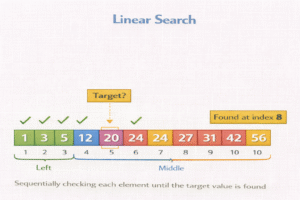
Linear Search (also called sequential search) is a simple searching algorithm that checks each element in a list one by one until it finds the target element or reaches the end of the list.
It works on both sorted and unsorted arrays.
How Linear Search Works (Step-by-Step)
- Start from the first element of the array.
- Compare each element with the target/key you are looking for.
- If a match is found, return the index.
- If no match is found by the end, return -1 (or say “not found”).
Example
Array: [12, 45, 67, 23, 89] Target: 23
Step-by-Step Execution:
| Step | Element Checked | Is it equal to 23? | Result |
| 1 | 12 | No | Continue |
| 2 | 45 | No | Continue |
| 3 | 67 | No | Continue |
| 4 | 23 | Yes | Found at index 3 |
Linear Search code:
PythonJavaCC++
# Linear Search

def linearSearch(arr, target):

    for i in range(len(arr)):

        if arr[i] == target:
            return i

    return -1


arr = [10, 20, 30, 40]

print(linearSearch(arr, 30))  # Output: 2
public class LinearSearch {

    static int linearSearch(int arr[], int target) {

        for (int i = 0; i < arr.length; i++) {

            if (arr[i] == target)
                return i;
        }

        return -1;
    }

    public static void main(String[] args) {

        int arr[] = {10,20,30,40};

        System.out.println(linearSearch(arr,30)); // 2
    }
}
#include <stdio.h>

int linearSearch(int arr[], int n, int target) {

    for (int i = 0; i < n; i++) {

        if (arr[i] == target)
            return i;
    }

    return -1;
}

int main() {

    int arr[] = {10,20,30,40};

    int index = linearSearch(arr,4,30);

    printf("%d\n", index);

    return 0;
}
#include <iostream>
#include <vector>
using namespace std;

int linearSearch(vector<int> arr, int target) {

    for (int i = 0; i < arr.size(); i++) {

        if (arr[i] == target)
            return i;
    }

    return -1;
}

int main() {

    vector<int> arr = {10,20,30,40};

    cout << linearSearch(arr,30); // 2

    return 0;
}
Time Complexity
| Case | Time Complexity |
| Best Case | O(1) |
| Average | O(n) |
| Worst Case | O(n) |
- n = number of elements
Space Complexity
- O (1) — no extra space used
Key Features:
- Simple and easy
- Works for unsorted arrays
- Not efficient for large data sets