Heap Sort Algorithm
Heap Sort is a comparison-based sorting algorithm that uses a binary heap data structure (usually a max heap). It repeatedly removes the largest element from the heap and places it at the end of the array.
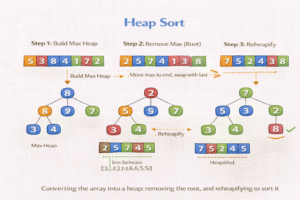
How Heap Sort Works (Step-by-Step)
- Build a Max Heap
- Convert the input array into a max heap.
- In a max heap, the largest element is at the root (index 0).
- Swap Root with Last Element
- Swap the first (largest) element with the last element of the array.
- Reduce Heap Size and Heapify
- Exclude the last element from the heap (it is now in correct position).
- Apply heapify to restore the max heap property.
- Repeat
- Continue the process until the heap size becomes 1.
Example of Heap Sort
Input Array:[5, 3, 8, 4, 1, 7, 2]
Step 1: Build Max Heap
Convert array into max heap:
→ [8, 4, 7, 3, 1, 5, 2]
Step 2: Swap Max (8) with Last (2)
Swap → [2, 4, 7, 3, 1, 5, 8]
Heapify remaining (ignore last sorted element):
→ [7, 4, 5, 3, 1, 2, 8]
Step 3: Swap Max (7) with Last Unsorted (2)
Swap → [2, 4, 5, 3, 1, 7, 8]
Heapify:
→ [5, 4, 2, 3, 1, 7, 8]
Step 4: Swap Max (5) with Last Unsorted (1)
Swap → [1, 4, 2, 3, 5, 7, 8]
Heapify:
→ [4, 3, 2, 1, 5, 7, 8]
Step 5: Swap Max (4) with Last Unsorted (1)
Swap → [1, 3, 2, 4, 5, 7, 8]
Heapify:
→ [3, 1, 2, 4, 5, 7, 8]
Step 6: Swap Max (3) with Last Unsorted (2)
Swap → [2, 1, 3, 4, 5, 7, 8]
Heapify:
→ [2, 1, 3, 4, 5, 7, 8]
Step 7: Swap Remaining
Swap 2 and 1 →
Final Sorted Array →[1, 2, 3, 4, 5, 7, 8]
Heap sort code:
# Heap Sort

def heapify(arr, n, i):

    largest = i
    left = 2 * i + 1
    right = 2 * i + 2

    if left  arr[largest]:
        largest = left

    if right  arr[largest]:
        largest = right

    if largest != i:

        arr[i], arr[largest] = arr[largest], arr[i]

        heapify(arr, n, largest)


def heap_sort(arr):

    n = len(arr)

    # Build Max Heap
    for i in range(n // 2 - 1, -1, -1):
        heapify(arr, n, i)

    # Extract elements
    for i in range(n - 1, 0, -1):

        arr[0], arr[i] = arr[i], arr[0]

        heapify(arr, i, 0)


def print_array(arr):

    for num in arr:
        print(num, end=" ")
    print()


arr = [12, 11, 13, 5, 6, 7]

print("Before Sorting:")
print_array(arr)

heap_sort(arr)

print("After Sorting:")
print_array(arr)
public class HeapSort {

    // Heap Sort function
    public static void heapSort(int[] arr) {

        int n = arr.length;

        // Build Max Heap
        for (int i = n / 2 - 1; i >= 0; i--)
            heapify(arr, n, i);

        // Extract elements
        for (int i = n - 1; i > 0; i--) {

            int temp = arr[0];
            arr[0] = arr[i];
            arr[i] = temp;

            heapify(arr, i, 0);
        }
    }

    // Heapify function
    public static void heapify(int[] arr, int n, int i) {

        int largest = i;
        int left = 2 * i + 1;
        int right = 2 * i + 2;

        if (left  arr[largest])
            largest = left;

        if (right  arr[largest])
            largest = right;

        if (largest != i) {

            int swap = arr[i];
            arr[i] = arr[largest];
            arr[largest] = swap;

            heapify(arr, n, largest);
        }
    }

    // Print array
    public static void printArray(int[] arr) {

        for (int num : arr)
            System.out.print(num + " ");

        System.out.println();
    }

    public static void main(String[] args) {

        int[] arr = {12, 11, 13, 5, 6, 7};

        System.out.println("Before Sorting:");
        printArray(arr);

        heapSort(arr);

        System.out.println("After Sorting:");
        printArray(arr);
    }
}
#include <stdio.h>

void heapify(int arr[], int n, int i) {

    int largest = i;
    int left = 2*i + 1;
    int right = 2*i + 2;

    if (left  arr[largest])
        largest = left;

    if (right  arr[largest])
        largest = right;

    if (largest != i) {

        int temp = arr[i];
        arr[i] = arr[largest];
        arr[largest] = temp;

        heapify(arr, n, largest);
    }
}

void heapSort(int arr[], int n) {

    for (int i = n/2 - 1; i >= 0; i--)
        heapify(arr, n, i);

    for (int i = n - 1; i > 0; i--) {

        int temp = arr[0];
        arr[0] = arr[i];
        arr[i] = temp;

        heapify(arr, i, 0);
    }
}

void printArray(int arr[], int n) {

    for (int i = 0; i < n; i++)
        printf("%d ", arr[i]);

    printf("\n");
}

int main() {

    int arr[] = {12,11,13,5,6,7};
    int n = 6;

    printf("Before Sorting:\n");
    printArray(arr, n);

    heapSort(arr, n);

    printf("After Sorting:\n");
    printArray(arr, n);

    return 0;
}
#include <iostream>
#include <vector>
using namespace std;

void heapify(vector<int>& arr, int n, int i) {

    int largest = i;
    int left = 2*i + 1;
    int right = 2*i + 2;

    if (left  arr[largest])
        largest = left;

    if (right  arr[largest])
        largest = right;

    if (largest != i) {

        swap(arr[i], arr[largest]);

        heapify(arr, n, largest);
    }
}

void heapSort(vector<int>& arr) {

    int n = arr.size();

    for (int i = n/2 - 1; i >= 0; i--)
        heapify(arr, n, i);

    for (int i = n - 1; i > 0; i--) {

        swap(arr[0], arr[i]);

        heapify(arr, i, 0);
    }
}

void printArray(vector<int> arr) {

    for (int num : arr)
        cout << num << " ";

    cout << endl;
}

int main() {

    vector<int> arr = {12,11,13,5,6,7};

    cout << "Before Sorting:" << endl;
    printArray(arr);

    heapSort(arr);

    cout << "After Sorting:" << endl;
    printArray(arr);

    return 0;
}
Time Complexity
| Case | Time Complexity |
| Best Case | O (n log n) |
| Average | O (n log n) |
| Worst Case | O (n log n) |
- Heap sort is not stable.
- It is in-place (no extra space is used except for recursion/heapify).
Space Complexity
- O (1) — It’s an in-place sorting algorithm.
Use Case:
Heap Sort is useful when you need guaranteed O(n log n) performance and don’t mind losing stability.